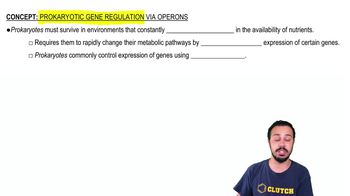
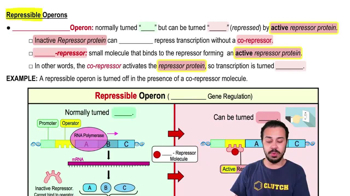
An operon is a group of genes transcribed together and controlled by one promoter, including structural genes and control regions like the promoter and operator.
What is the difference between inducible and repressible operons?
In an inducible operon, transcription is usually off and must be turned on. In a repressible operon, transcription is usually on and must be turned off.
What enzymes are encoded by the lac operon in E. coli?
The lac operon encodes β-galactosidase, lac permease (for lactose transport), and transacetylase (which adds an acetyl group to galactose).
How does the lac operon repressor protein regulate transcription?
The repressor protein binds to the operator to block transcription when lactose is absent. When lactose is present, it binds to a lactose metabolite, preventing repressor binding and allowing transcription.
How is the trp operon regulated?
The trp operon is a repressible operon where excess tryptophan acts as a corepressor, binding to the repressor protein, which then binds the operator to stop transcription.
What role does cyclic AMP (cAMP) play in lac operon regulation?
When glucose is low, cAMP levels rise and bind to CAP, which then binds the lac promoter to enhance RNA polymerase binding and transcription.
What is catabolite repression?
Catabolite repression is the inhibition of metabolism of alternative carbon sources by glucose, mediated by low cAMP levels when glucose is present.
What is the function of the operator in an operon?
The operator is a DNA segment that acts as a regulatory 'traffic light' controlling whether RNA polymerase can transcribe the structural genes.
What is the role of the regulatory gene (I gene) in the lac operon?
The regulatory gene encodes the repressor protein that controls the operon's transcription by binding or releasing the operator.
What is epigenetic control in bacteria?
Epigenetic control involves turning genes off by methylating nucleotides, which can be inherited but is reversible, affecting gene expression without changing DNA sequence.
What is a riboswitch and its role in post-transcriptional control?
A riboswitch is a part of mRNA that binds a substrate and changes mRNA structure to initiate or stop translation.
What are microRNAs (miRNAs) and their function?
miRNAs are ~22 nucleotide single-stranded RNAs that inhibit protein production by base-pairing with complementary mRNA, leading to mRNA degradation.
How do miRNAs affect bacterial growth in humans?
Host-produced miRNAs influence the growth of intestinal bacteria by promoting growth of different bacterial phyla.
Why do cells prefer glucose over lactose as a carbon source?
Cells use glucose first because it is metabolized more efficiently; presence of glucose lowers cAMP, preventing lac operon activation.
What happens to lac operon transcription when both glucose and lactose are present?
Transcription is low because glucose presence lowers cAMP, so CAP does not activate the lac promoter despite lactose presence.
What causes transcription of a repressible enzyme operon?
Transcription occurs when the corepressor (e.g., tryptophan) is absent, leaving the repressor inactive and unable to bind the operator.
What is the start codon and its significance in translation?
The start codon (AUG) signals the beginning of translation and codes for methionine, initiating protein synthesis.
What is the genetic code?
The genetic code is the set of codons in mRNA that specify amino acids during translation.
How does the lac operon respond to lactose availability?
Lactose presence inactivates the repressor, allowing transcription of lac genes to produce enzymes for lactose metabolism.
What is the role of CAP in positive regulation of the lac operon?
CAP binds cAMP and then the lac promoter to enhance RNA polymerase binding, increasing transcription when glucose is scarce.
 Back
Back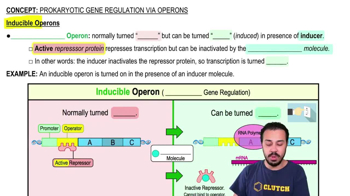
 04:25
04:25