Ch. 1 - A Brief History of Microbiology
Bauman - Microbiology with Diseases by Taxonomy 6th Edition
Bauman6th EditionMicrobiology with Diseases by TaxonomyISBN: 9780134832302Not the one you use?Change textbook
Chapter 1, Problem 4

Fill in the blanks with the name(s) of the scientist(s) whose investigations led to the following fields of study in microbiology.
Immunology____________.

Verified step by step guidance
1
Understand that the question asks for the name(s) of the scientist(s) who contributed to the foundation of immunology, a branch of microbiology focused on the immune system and its response to pathogens.
Recall that immunology as a scientific field began with studies on how organisms defend themselves against infections, particularly through the work on vaccines and immune responses.
Identify Edward Jenner as a key figure, known for developing the smallpox vaccine, which was the first successful vaccine and a cornerstone in immunology.
Consider Louis Pasteur, who further advanced immunology by developing vaccines for rabies and anthrax and promoting the germ theory of disease.
Conclude that the names Edward Jenner and Louis Pasteur are commonly credited for their foundational work in immunology.

Verified video answer for a similar problem:

This video solution was recommended by our tutors as helpful for the problem above.
Video duration:
1m
Was this helpful?

Key Concepts

Here are the essential concepts you must grasp in order to answer the question correctly.

Immunology

Immunology is the branch of microbiology that studies the immune system and how organisms defend themselves against pathogens. It involves understanding immune responses, antibodies, and vaccines. The field was pioneered by scientists like Edward Jenner and Louis Pasteur, who developed early vaccines and laid the foundation for immunological research.

Role of Scientists in Microbiology

Many microbiology fields are named or defined based on the contributions of key scientists whose experiments and discoveries established foundational knowledge. Recognizing these scientists helps understand the historical development and principles behind each subfield, such as immunology, bacteriology, and virology.
Recommended video:
Guided course
07:27
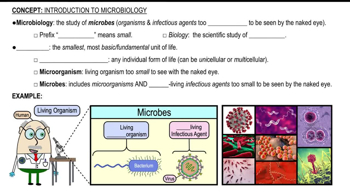
Introduction to Microbiology

Historical Development of Microbiology

Microbiology evolved through the work of various scientists who identified microbes and their roles in disease and immunity. Understanding this historical context provides insight into how scientific methods and discoveries shaped modern microbiology, including the emergence of immunology as a distinct discipline.
Recommended video:
Guided course
07:27
Introduction to Microbiology