
Whereas the first edition of Bergey’s Manual relied on morphological and biochemical characteristics to classify microbes, the new edition focuses on ribosomal RNA sequences. List several other criteria for grouping and classifying bacteria.
Ch. 11 - Characterizing and Classifying Prokaryotes
Bauman6th EditionMicrobiology with Diseases by TaxonomyISBN: 9780134832302Not the one you use?Change textbook
Chapter 11, Problem 1
The type of reproduction in prokaryotes that results in a palisade arrangement of cells is called ___________ .
a. pleomorphic division
b. endospore formation
c. snapping division
d. binary fission
Verified step by step guidance1
Understand the question: It asks for the type of reproduction in prokaryotes that leads to a palisade arrangement of cells. A palisade arrangement means cells are aligned side by side like a fence or a stack of rods.
Review the options:
- Pleomorphic division refers to variable shapes of cells, not a specific division pattern.
- Endospore formation is a survival mechanism, not a reproductive division.
- Snapping division is a type of cell division where the daughter cells remain attached in a characteristic angular arrangement.
- Binary fission is the common method of prokaryotic reproduction where one cell divides into two identical cells.
Recall that snapping division is a modified form of binary fission where the outer cell wall breaks unevenly, causing the daughter cells to remain attached at an angle, producing a palisade arrangement.
Eliminate options that do not fit the description of producing a palisade arrangement: pleomorphic division and endospore formation do not produce this arrangement, and binary fission typically results in separated cells.
Conclude that the correct type of reproduction resulting in a palisade arrangement is snapping division.

Verified video answer for a similar problem:
This video solution was recommended by our tutors as helpful for the problem above.
Video duration:
1mWas this helpful?
Key Concepts
Here are the essential concepts you must grasp in order to answer the question correctly.
Snapping Division
Snapping division is a type of cell division in some prokaryotes where the outer cell wall breaks unevenly, causing daughter cells to remain attached at an angle. This results in characteristic arrangements like palisades, where cells line up side by side resembling a fence.
Recommended video:
Guided course
Meiosis
Binary Fission
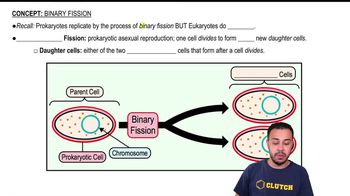
Binary fission is the most common form of reproduction in prokaryotes, involving the replication of DNA followed by the division of the cell into two identical daughter cells. It typically produces single cells or chains but does not usually create palisade arrangements.
Recommended video:
Guided course
Binary Fission
Palisade Arrangement
A palisade arrangement refers to a pattern where rod-shaped bacterial cells align side by side in a fence-like formation. This arrangement often results from specific division mechanisms like snapping division, which influence how cells remain attached after division.
Recommended video:
Guided course
Cocci Bacterial Cell Arrangements
Related Practice
Textbook Question
1526
views
Textbook Question
For each of the following statements that is true, write “true” in the blank. For each statement that is false, write the word(s) that should be substituted for the underlined word(s) to make the statement correct.
__________ All prokaryotes reproduce sexually.
906
views
Textbook Question
Describe the location of these endospores within their cells.
(a) <Image>
(b) <Image>
1599
views
Textbook Question
Label the shapes of these prokaryotic cells.
a. ___________ <IMAGE>
b. ___________ <IMAGE>
c. ___________ <IMAGE>
d. ___________ <IMAGE>
e. ___________ <IMAGE> stiff
f. ___________ <IMAGE> flexible
g. ___________ <IMAGE>
1241
views
