Ch. 12 - Characterizing and Classifying Eukaryotes
Bauman - Microbiology with Diseases by Taxonomy 6th Edition
Bauman6th EditionMicrobiology with Diseases by TaxonomyISBN: 9780134832302Not the one you use?Change textbook
Chapter 12, Problem 1

Match the terms below with their corresponding definitions.


1. _________Mitosis
2. _________Meiosis
3. _________Homologous chromosomes
4. _________Crossing over
5. _________Cytokinesis


A. Cytoplasmic division
B. Diploid nuclei producing haploid nuclei
C. Results in genetic variation
D. Carry similar genes
E. Diploid nuclei producing diploid nuclei

Verified step by step guidance
1
Step 1: Understand the definition of Mitosis. Mitosis is a type of cell division where a diploid nucleus divides to produce two diploid nuclei, maintaining the chromosome number. Match this with option E: 'Diploid nuclei producing diploid nuclei'.
Step 2: Understand Meiosis. Meiosis is a special type of cell division that reduces the chromosome number by half, producing haploid nuclei from diploid nuclei. Match this with option B: 'Diploid nuclei producing haploid nuclei'.
Step 3: Define Homologous chromosomes. These are pairs of chromosomes that carry similar genes, one inherited from each parent. Match this with option D: 'Carry similar genes'.
Step 4: Understand Crossing over. This is the process during meiosis where homologous chromosomes exchange genetic material, leading to genetic variation. Match this with option C: 'Results in genetic variation'.
Step 5: Define Cytokinesis. This is the division of the cytoplasm following nuclear division, resulting in two separate cells. Match this with option A: 'Cytoplasmic division'.

Verified video answer for a similar problem:

This video solution was recommended by our tutors as helpful for the problem above.
Video duration:
3m
Was this helpful?

Key Concepts

Here are the essential concepts you must grasp in order to answer the question correctly.

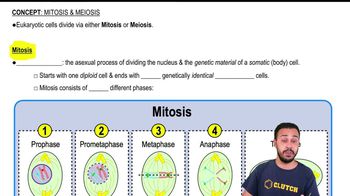
Mitosis

Mitosis is a type of cell division where a diploid nucleus divides to produce two genetically identical diploid daughter nuclei. It is essential for growth, tissue repair, and asexual reproduction in eukaryotic organisms.
Recommended video:

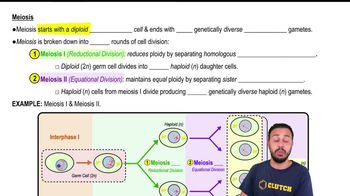
Meiosis

Meiosis is a specialized cell division that reduces the chromosome number by half, producing haploid nuclei from diploid cells. This process is crucial for sexual reproduction and generates genetic diversity through recombination.
Recommended video:

Crossing Over

Crossing over is the exchange of genetic material between homologous chromosomes during meiosis. This process increases genetic variation by creating new combinations of alleles in gametes.
Recommended video:
Guided course
05:31
Which Molecules Freely Cross Membranes?