The study of where and when diseases occur and how they are transmitted within populations is ___________ .
Ch. 14 - Infection, Infectious Diseases, and Epidemiology
Bauman6th EditionMicrobiology with Diseases by TaxonomyISBN: 9780134832302Not the one you use?Change textbook
Chapter 14, Problem 4
List Koch’s four postulates, and describe situations in which not all may be applicable.
Verified step by step guidance1
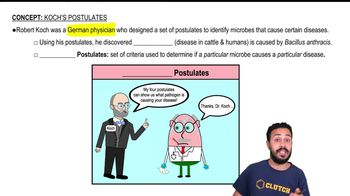
Step 1: Understand Koch's four postulates, which are criteria designed to establish a causative relationship between a microbe and a disease. They are: (1) The microorganism must be found in all organisms suffering from the disease, but not in healthy organisms. (2) The microorganism must be isolated from a diseased organism and grown in pure culture. (3) The cultured microorganism should cause disease when introduced into a healthy organism. (4) The microorganism must be re-isolated from the experimentally infected host and identified as being identical to the original specific causative agent.
Step 2: Recognize that these postulates are foundational in microbiology for linking pathogens to diseases, but they have limitations in certain contexts.
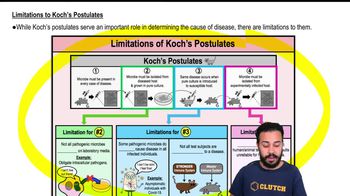
Step 3: Identify situations where Koch's postulates may not be fully applicable, such as when the microorganism cannot be cultured in vitro (e.g., viruses that require host cells), or when asymptomatic carriers harbor the pathogen without showing disease symptoms.
Step 4: Consider diseases caused by multiple pathogens or those influenced by host factors, where a single microorganism may not fulfill all postulates, such as polymicrobial infections or diseases with complex etiologies.
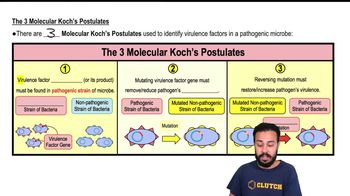
Step 5: Summarize that while Koch's postulates provide a useful framework, modern microbiology often uses molecular and genetic evidence to complement or modify these criteria when studying pathogens that do not meet all traditional postulates.

Verified video answer for a similar problem:
This video solution was recommended by our tutors as helpful for the problem above.
Video duration:
2mWas this helpful?
Key Concepts
Here are the essential concepts you must grasp in order to answer the question correctly.
Koch’s Four Postulates
Koch’s four postulates are criteria established to link a specific microorganism to a particular disease. They include: the microorganism must be found in all diseased individuals, isolated and grown in pure culture, cause disease when introduced to a healthy host, and be re-isolated from the experimentally infected host.
Recommended video:
Guided course
Koch's Postulates
Limitations of Koch’s Postulates
Not all diseases meet Koch’s postulates due to factors like asymptomatic carriers, inability to culture some pathogens, or diseases caused by multiple organisms. For example, viruses require host cells to grow, making pure culture isolation impossible, and some chronic diseases involve complex microbial communities.
Recommended video:
Guided course
Limitations to Koch's Postulates
Modern Adaptations and Molecular Koch’s Postulates
Modern microbiology uses molecular techniques to overcome limitations of traditional postulates. Molecular Koch’s postulates focus on identifying specific genes responsible for pathogenicity, allowing the study of pathogens that cannot be cultured or cause disease only under certain conditions.
Recommended video:
Guided course
The 3 Molecular Koch's Postulates
Related Practice
Textbook Question
1713
views
Textbook Question
The process by which microorganisms attach themselves to cells is :
a. Infection
b. Contamination
c. Disease
d. Adhesion
1175
views
Textbook Question
The most frequent portal of entry for pathogens is:
a. The respiratory tract
b. The skin
c. The conjunctiva
d. A cut or wound
1450
views
Textbook Question
List three portals through which pathogens enter the body.
1227
views
Textbook Question
Diseases that are naturally spread from their usual animal hosts to humans are called ___________ .
1071
views
Textbook Question
Which of the following is false concerning microbial contaminants?
a. Contaminants may become opportunistic pathogens.
b. Most microbial contaminants will eventually cause harm.
c. Contaminants may be a part of the transient microbiota.
d. Contaminants may be introduced by a mosquito bite.
765
views