
Ch. 14 - Infection, Infectious Diseases, and Epidemiology
Bauman - Microbiology with Diseases by Taxonomy 6th Edition
Bauman6th EditionMicrobiology with Diseases by TaxonomyISBN: 9780134832302Not the one you use?Change textbook
Chapter 14, Problem 15

Which of the following phrases describes a contagious disease?
a. A disease arising from fomites
b. A disease that is easily passed from host to host in aerosols
c. A disease that arises from opportunistic members of the resident microbiome
d. Both a and b

Verified step by step guidance
1
Step 1: Understand the definition of a contagious disease. A contagious disease is one that can be easily transmitted from one host to another, often through direct contact or respiratory droplets (aerosols).
Step 2: Analyze option (a): 'A disease arising from fomites.' Fomites are inanimate objects that can carry infectious agents, but diseases transmitted this way are not necessarily contagious in the strict sense, as fomites are indirect transmission routes.
Step 3: Analyze option (b): 'A disease that is easily passed from host to host in aerosols.' This fits the definition of a contagious disease because aerosols allow direct and efficient transmission between hosts.
Step 4: Analyze option (c): 'A disease that arises from opportunistic members of the resident microbiome.' These diseases are typically not contagious because they originate from the host's own microbiome rather than being transmitted between hosts.
Step 5: Conclude that the phrase describing a contagious disease is option (b), since it directly involves easy transmission between hosts via aerosols.

Verified video answer for a similar problem:

This video solution was recommended by our tutors as helpful for the problem above.
Video duration:
1m
Was this helpful?

Key Concepts

Here are the essential concepts you must grasp in order to answer the question correctly.

Contagious Disease

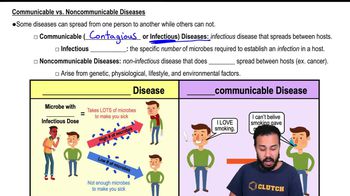
A contagious disease is an infectious illness that spreads easily from one host to another, often through direct contact or respiratory droplets. It typically involves pathogens that can be transmitted via aerosols, bodily fluids, or close physical interaction.
Recommended video:
Guided course
04:57
Communicable vs. Noncommunicable Diseases

Fomites and Disease Transmission

Fomites are inanimate objects or surfaces that can carry infectious agents and facilitate indirect transmission of diseases. While diseases can arise from fomites, this mode of transmission is considered indirect and may not always classify a disease as contagious.
Recommended video:
Guided course
04:57
Communicable vs. Noncommunicable Diseases

Opportunistic Infections from Resident Microbiome

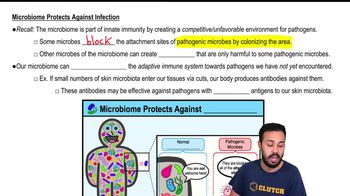
Opportunistic infections occur when normally harmless microbes from the resident microbiome cause disease, usually when the host's immune system is compromised. These infections are not typically contagious since they originate from the host's own microbial flora.
Recommended video:
Guided course
06:22
Microbiome Protects Against Infection