Ch. 16 - Adaptive Immunity
Bauman - Microbiology with Diseases by Taxonomy 6th Edition
Bauman6th EditionMicrobiology with Diseases by TaxonomyISBN: 9780134832302Not the one you use?Change textbook
Chapter 16, Problem 1

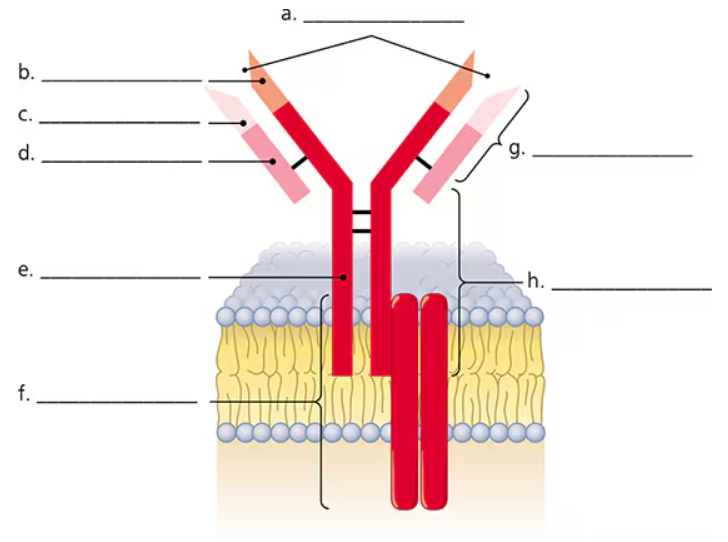
Label the parts of the immunoglobulin pictured here.
Diagram of an immunoglobulin molecule with labeled parts and blank lines for identification.


a. ________
b. ________
c. ________
d. ________
e. ________
f. ________
g. ________
h. ________

Verified step by step guidance
1
Step 1: Identify the overall structure of the immunoglobulin (antibody) molecule. It has a Y-shaped structure with two identical heavy chains and two identical light chains.
Step 2: Label 'a' as the 'Antigen-binding site' located at the tips of the Y arms where the antibody binds to the antigen.
Step 3: Label 'b' as the 'Light chain,' which is the smaller polypeptide chain on each arm of the Y.
Step 4: Label 'c' as the 'Variable region' of the light chain, which is responsible for antigen specificity.
Step 5: Label 'd' as the 'Constant region' of the light chain, which provides structural support.
Step 6: Label 'e' as the 'Heavy chain,' the larger polypeptide chain forming the inner part of each arm and the stem of the Y.
Step 7: Label 'f' as the 'Transmembrane region' or 'Membrane-spanning region,' which anchors the antibody to the B cell membrane.
Step 8: Label 'g' as the 'Fab region' (Fragment antigen-binding), which includes the variable and constant regions of both heavy and light chains and is responsible for antigen binding.
Step 9: Label 'h' as the 'Fc region' (Fragment crystallizable), which is the stem of the Y formed by the constant regions of the heavy chains and mediates effector functions.

Verified video answer for a similar problem:

This video solution was recommended by our tutors as helpful for the problem above.
Video duration:
1m
Was this helpful?

Key Concepts

Here are the essential concepts you must grasp in order to answer the question correctly.

Structure of Immunoglobulin (Antibody) Molecule

Immunoglobulins are Y-shaped proteins composed of two heavy chains and two light chains. The arms of the Y contain variable regions that bind antigens, while the stem (Fc region) interacts with immune cells. Understanding this structure is essential for identifying labeled parts in diagrams.
Recommended video:
Guided course
05:40
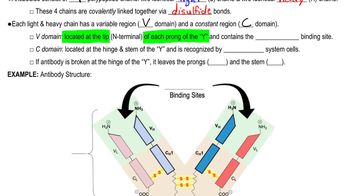
Antibody Structure

Variable and Constant Regions

The variable regions of both heavy and light chains are responsible for antigen specificity, allowing antibodies to recognize diverse pathogens. The constant regions determine the antibody class and mediate effector functions. Differentiating these regions helps in labeling immunoglobulin parts.
Recommended video:
Guided course
03:18
Genome Variability

Antigen-Binding Sites and Fc Region

The antigen-binding sites are located at the tips of the variable regions on the Fab (fragment antigen-binding) arms. The Fc (fragment crystallizable) region forms the stem and interacts with immune cells and complement proteins, triggering immune responses. Recognizing these functional areas aids in understanding antibody action.
Recommended video:
Guided course
09:16
Outcomes of Antibody Binding to Antigen