Ch. 17 - Immunization and Immune Testing
Bauman - Microbiology with Diseases by Taxonomy 6th Edition
Bauman6th EditionMicrobiology with Diseases by TaxonomyISBN: 9780134832302Not the one you use?Change textbook
Chapter 17, Problem 15

Anti–human antibody antibodies are:
a. Found in immunocompromised individuals
b. Used in direct fluorescent immunoassays
c. Formed by animals reacting to human immunoglobulins
d. An alternative method in ELISA

Verified step by step guidance
1
Understand the term 'anti-human antibody antibodies': these are antibodies generated against human antibodies, typically produced by immunizing animals with human immunoglobulins.
Evaluate option (a): 'Found in immunocompromised individuals' — consider whether immunocompromised people produce antibodies against their own antibodies, which is generally not the case.
Evaluate option (b): 'Used in direct fluorescent immunoassays' — recall that anti-human antibodies can be labeled with fluorescent tags and used as secondary antibodies to detect human antibodies in such assays.
Evaluate option (c): 'Formed by animals reacting to human immunoglobulins' — this aligns with the concept that animals produce these antibodies when exposed to human antibodies, making this a likely correct description.
Evaluate option (d): 'An alternative method in ELISA' — consider that anti-human antibodies are often used as secondary antibodies in ELISA, but they are not an alternative method themselves; rather, they are reagents within the method.

Verified video answer for a similar problem:

This video solution was recommended by our tutors as helpful for the problem above.
Video duration:
2m
Was this helpful?

Key Concepts

Here are the essential concepts you must grasp in order to answer the question correctly.

Anti-human antibodies

Anti-human antibodies are antibodies produced by animals, such as rabbits or mice, in response to human immunoglobulins. These antibodies specifically recognize and bind to human antibodies, making them useful tools in immunological assays.
Recommended video:
Guided course
03:25
The Human Microbiome

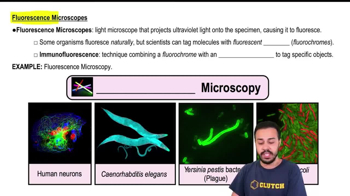
Direct fluorescent immunoassays (DFA)

Direct fluorescent immunoassays use fluorescently labeled antibodies to detect specific antigens or antibodies in a sample. Anti-human antibodies can be conjugated with fluorescent dyes to bind human antibodies, enabling visualization under a fluorescence microscope.
Recommended video:
Guided course
02:54
Fluorescence Microscopes

Enzyme-linked immunosorbent assay (ELISA)

ELISA is a common laboratory technique that uses enzyme-linked antibodies to detect and quantify antigens or antibodies. Anti-human antibodies can serve as secondary antibodies in ELISA, binding to human antibodies to produce a measurable enzymatic signal.
Recommended video:
Guided course
04:21
Plaque Assays