Compare and contrast the Chinese practice of variolation with Jenner’s vaccination procedure.
Ch. 17 - Immunization and Immune Testing
Bauman6th EditionMicrobiology with Diseases by TaxonomyISBN: 9780134832302Not the one you use?Change textbook
Chapter 17, Problem 1
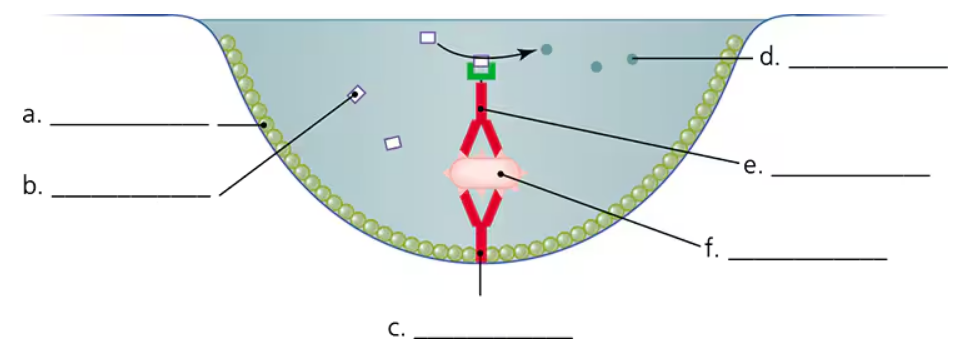
Identify the chemicals represented by this artist’s conception of an antibody sandwich ELISA.

Verified step by step guidance1
Step 1: Identify the component labeled 'a'. This is the solid surface or well where the assay takes place, typically a microtiter plate well coated with a capture antibody.
Step 2: Identify the component labeled 'b'. This is the capture antibody that is immobilized on the solid surface and is specific to the antigen of interest.
Step 3: Identify the component labeled 'c'. This is the antigen that binds specifically to the capture antibody, forming the first part of the 'sandwich'.
Step 4: Identify the component labeled 'd'. This is the detection antibody, which binds to a different epitope on the antigen, allowing for specific detection.
Step 5: Identify the components labeled 'e' and 'f'. 'e' is the enzyme conjugated to the detection antibody, which catalyzes a colorimetric or other detectable reaction, and 'f' is the substrate that the enzyme acts upon to produce a measurable signal.

Verified video answer for a similar problem:
This video solution was recommended by our tutors as helpful for the problem above.
Video duration:
2mWas this helpful?
Key Concepts
Here are the essential concepts you must grasp in order to answer the question correctly.
Capture Antibody
The capture antibody is immobilized on the surface of the well and specifically binds to the target antigen. It serves as the first layer in the sandwich ELISA, ensuring that only the antigen of interest is retained for detection.
Recommended video:
Guided course
Antibodies
Antigen
The antigen is the molecule of interest that is specifically recognized and bound by both the capture and detection antibodies. It is 'sandwiched' between these antibodies, allowing for its identification and quantification.
Recommended video:
Guided course
Antigens
Detection Antibody and Enzyme Label
The detection antibody binds to a different epitope on the antigen and is linked to an enzyme (such as horseradish peroxidase). This enzyme catalyzes a colorimetric reaction when substrate is added, producing a measurable signal proportional to antigen concentration.
Recommended video:
Guided course
Mutant Detection
Related Practice
Textbook Question
1592
views
Textbook Question
To obtain immediate immunity against tetanus, a patient should receive:
a. An attenuated vaccine of Clostridium tetani
b. A modified live vaccine of C. tetani
c. Tetanus toxoid
d. Immunoglobulin against tetanus toxin (antitoxin)
1410
views
Textbook Question
_______ Passive immunotherapy provides more prolonged immunity than active immunization.
1541
views
Textbook Question
In the blank before each description, write the letter of the matching term. Some choices may be used more than once.
1._____ Induces rapid onset of immunity
2._____Induces mainly an antibody response
3. _____Induces good cell-mediated immunity
4. _____Increases antigenicity
5. _____Uses antigen fragments
6. _____Uses attenuated microbes
A. Attenuated viral vaccine
B. Adjuvant
C. Subunit vaccine
D. Immunoglobulin
E. Residual virulence
1369
views