Ch. 18 - Immune Disorders
Bauman - Microbiology with Diseases by Taxonomy 6th Edition
Bauman6th EditionMicrobiology with Diseases by TaxonomyISBN: 9780134832302Not the one you use?Change textbook
Chapter 18, Problem 1

The immunoglobulin class that mediates type I hypersensitivity is:
a. IgA
b. IgM
c. IgG
d. IgD
e. IgE

Verified step by step guidance
1
Understand that type I hypersensitivity reactions are immediate allergic reactions mediated by a specific class of immunoglobulin.
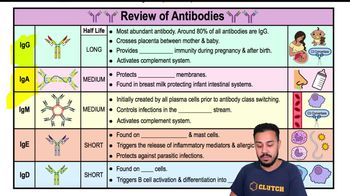
Recall the functions of different immunoglobulin classes: IgA is mainly found in mucosal areas, IgM is the first antibody produced in an immune response, IgG is the most abundant antibody in serum, IgD is primarily a receptor on B cells, and IgE is involved in allergic responses.
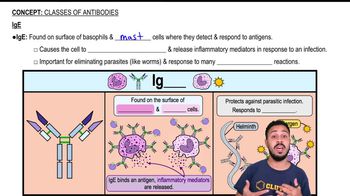
Identify that type I hypersensitivity involves the binding of an allergen to IgE antibodies attached to mast cells and basophils, leading to the release of histamine and other mediators.
Conclude that the immunoglobulin class responsible for mediating type I hypersensitivity is IgE.
Match the correct answer choice to IgE, which is option e.

Verified video answer for a similar problem:

This video solution was recommended by our tutors as helpful for the problem above.
Video duration:
2m
Was this helpful?

Key Concepts

Here are the essential concepts you must grasp in order to answer the question correctly.

Type I Hypersensitivity

Type I hypersensitivity is an immediate allergic reaction triggered by allergens, leading to symptoms like itching, swelling, and anaphylaxis. It involves the activation of mast cells and basophils through antibody binding, causing the release of histamine and other mediators.
Recommended video:
Guided course
01:06
Types of Phosphorylation

Immunoglobulin E (IgE)

IgE is a class of antibodies primarily involved in allergic responses and defense against parasitic infections. It binds to allergens and triggers mast cell degranulation, which releases histamine and other chemicals responsible for type I hypersensitivity symptoms.
Recommended video:

Other Immunoglobulin Classes

Immunoglobulins like IgA, IgM, IgG, and IgD have distinct roles: IgA protects mucosal surfaces, IgM is the first antibody in immune responses, IgG provides long-term immunity, and IgD functions mainly as a B cell receptor. None of these mediate type I hypersensitivity.
Recommended video:
Guided course
03:48
Review Table of Immunoglobin Classes
Related Practice
Textbook Question

The major inflammatory mediator released by degranulating mast cells in type I hypersensitivity is:

a. Immunoglobulin

b. Complement

c. Histamine

d. Interleukin

e. Prostaglandin

1373
views

Textbook Question

Put the number of the type of immune system hypersensitivity in the blank next to each manifestation. Each of the four types may be used more than once or not at all. If the manifestation is not an immune hypersensitivity, put zero in the blank.

1. Acute anaphylaxis

2. Allergic contact dermatitis

3. Systemic lupus erythematosus

4. Allograft rejection

5. AIDS

6. Graft-versus-host disease

7. Milk allergy

8. Rheumatoid arthritis (RA)

9. Asthma

10. Hay fever

I. Type I hypersensitivity

II. Type II hypersensitivity

III. Type III hypersensitivity

IV. Type IV hypersensitivity

0. Not a hypersensitivity

1392
views
Textbook Question

Indicate whether each statement is true or false. If the statement is false, change the underlined word or phrase to make the statement true.

________ Cyclosporine is released by degranulating mast cells.

705
views
Textbook Question

Indicate whether each statement is true or false. If the statement is false, change the underlined word or phrase to make the statement true.

_____ Type III hypersensitivity reactions may lead to the development of glomerulonephritis.

737
views
Textbook Question

Why is a child born to an Rh+ mother not susceptible to Rh-related hemolytic disease of the newborn?

1454
views
Textbook Question

Label the four types of grafts on the accompanying figure.

1606
views