Ch. 18 - Immune Disorders
Bauman - Microbiology with Diseases by Taxonomy 6th Edition
Bauman6th EditionMicrobiology with Diseases by TaxonomyISBN: 9780134832302Not the one you use?Change textbook
Chapter 18, Problem 6

Which of the following is an autoimmune disease?
a. A heart attack
b. Acute anaphylaxis
c. Farmer’s lung
d. Graft-versus-host disease
e. Systemic lupus erythematosus

Verified step by step guidance
1
Step 1: Understand the definition of an autoimmune disease. Autoimmune diseases occur when the immune system mistakenly attacks the body's own tissues, recognizing them as foreign.
Step 2: Review each option to determine if it fits the criteria of an autoimmune disease:
Step 3: Analyze option (a) A heart attack – this is caused by blockage of blood flow to the heart muscle, not by immune system attacking self-tissues, so it is not autoimmune.
Step 4: Analyze option (b) Acute anaphylaxis – this is a severe allergic reaction caused by hypersensitivity to an external allergen, not an autoimmune response.
Step 5: Analyze option (c) Farmer’s lung – this is a hypersensitivity pneumonitis caused by inhalation of organic dust, an immune reaction to external antigens, not autoimmune.
Step 6: Analyze option (d) Graft-versus-host disease – this occurs when transplanted immune cells attack the recipient’s tissues; it is an immune reaction but not an autoimmune disease because the immune cells are foreign.
Step 7: Analyze option (e) Systemic lupus erythematosus (SLE) – this is a classic autoimmune disease where the immune system attacks multiple organs and tissues of the body.
Step 8: Conclude that the correct answer is the option that represents an autoimmune disease, which is systemic lupus erythematosus.

Verified video answer for a similar problem:

This video solution was recommended by our tutors as helpful for the problem above.
Video duration:
2m
Was this helpful?

Key Concepts

Here are the essential concepts you must grasp in order to answer the question correctly.

Autoimmune Disease

An autoimmune disease occurs when the immune system mistakenly attacks the body's own tissues, leading to chronic inflammation and tissue damage. Examples include systemic lupus erythematosus and rheumatoid arthritis. Understanding this helps differentiate autoimmune conditions from other immune-related disorders.
Recommended video:
Guided course
04:57
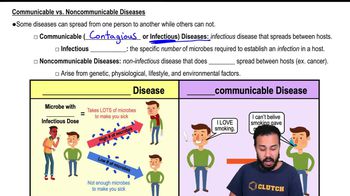
Communicable vs. Noncommunicable Diseases

Hypersensitivity Reactions

Hypersensitivity reactions are exaggerated immune responses to antigens, classified into four types (I-IV). Acute anaphylaxis is a type I hypersensitivity involving rapid allergic reactions, while farmer’s lung is a type III hypersensitivity caused by immune complex deposition. Recognizing these helps distinguish allergic and immune complex diseases from autoimmune diseases.
Recommended video:
Guided course
01:56
Chemical Reactions

Graft-versus-Host Disease (GVHD)

GVHD is a condition where transplanted donor immune cells attack the recipient's tissues, commonly after bone marrow transplants. It is an immune-mediated disease but not autoimmune, as the immune response is directed against foreign host tissues rather than self. This distinction is key in identifying autoimmune diseases.
Recommended video:
Guided course
04:57
Communicable vs. Noncommunicable Diseases