Ch. 2 - The Chemistry of Microbiology
Bauman - Microbiology with Diseases by Taxonomy 6th Edition
Bauman6th EditionMicrobiology with Diseases by TaxonomyISBN: 9780134832302Not the one you use?Change textbook
Chapter 2, Problem 4

Which of the following is not an organic compound?


a. Monosaccharide
b. Formaldehyde
c. Water
d. Steroid

Verified step by step guidance
1
Understand the definition of an organic compound: Organic compounds primarily contain carbon atoms bonded to hydrogen atoms, often with oxygen, nitrogen, and other elements. They are typically associated with living organisms.
Review each option to identify if it fits the criteria of an organic compound:
a. Monosaccharides are simple sugars composed of carbon, hydrogen, and oxygen, making them organic compounds.
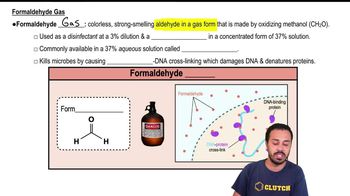
b. Formaldehyde is a simple organic molecule containing carbon bonded to hydrogen and oxygen, so it is an organic compound.
c. Water (H2O) consists of hydrogen and oxygen but does not contain carbon, so it is an inorganic compound.
d. Steroids are complex organic molecules made of carbon rings and hydrogen atoms, classifying them as organic compounds.

Verified video answer for a similar problem:

This video solution was recommended by our tutors as helpful for the problem above.
Video duration:
1m
Was this helpful?

Key Concepts

Here are the essential concepts you must grasp in order to answer the question correctly.

Organic Compounds

Organic compounds primarily contain carbon atoms bonded to hydrogen, oxygen, or other elements, forming the basis of life’s molecules such as carbohydrates, lipids, proteins, and nucleic acids. They are typically associated with living organisms and include complex structures like steroids and monosaccharides.
Recommended video:
Guided course
05:22
Scientific Naming of Organisms

Inorganic Compounds

Inorganic compounds generally lack carbon-hydrogen bonds and include substances like water, salts, and minerals. These compounds are not typically produced by living organisms and play essential roles in biological systems, such as water’s function as a solvent and medium for biochemical reactions.
Recommended video:
Guided course
02:27
Phenolic Compounds

Chemical Structure of Formaldehyde

Formaldehyde (CH2O) is a simple organic compound containing carbon bonded to hydrogen and oxygen. Despite its simplicity, it is classified as organic because it has carbon-hydrogen bonds, distinguishing it from inorganic molecules like water.
Recommended video:
Guided course
02:56
Formaldehyde Gas