Ch. 20 - Pathogenic Gram-Negative Cocci and Bacilli
Bauman - Microbiology with Diseases by Taxonomy 6th Edition
Bauman6th EditionMicrobiology with Diseases by TaxonomyISBN: 9780134832302Not the one you use?Change textbook
Chapter 20, Problem 4

Statistics show that meningococcal diseases are more frequent in college dormitories and military barracks than in the population at large. Suggest an explanation of this observation.

Verified step by step guidance
1
Understand the nature of meningococcal diseases, which are caused by the bacterium Neisseria meningitidis and are transmitted through respiratory droplets or close contact.
Recognize that environments like college dormitories and military barracks involve close living quarters where individuals are in frequent and prolonged close contact, facilitating the spread of respiratory pathogens.
Consider factors such as shared personal items, crowded sleeping arrangements, and social behaviors that increase the likelihood of transmission in these settings.
Acknowledge that stress, fatigue, and possibly compromised immunity in these populations can also contribute to increased susceptibility to infection.
Conclude that the combination of close proximity, increased contact rates, and environmental factors in dormitories and barracks leads to a higher incidence of meningococcal disease compared to the general population.

Verified video answer for a similar problem:

This video solution was recommended by our tutors as helpful for the problem above.
Video duration:
3m
Was this helpful?

Key Concepts

Here are the essential concepts you must grasp in order to answer the question correctly.

Transmission of Meningococcal Disease

Meningococcal disease spreads through respiratory droplets and close contact, making crowded environments like dormitories and barracks ideal for transmission. Prolonged close proximity increases the chance of inhaling infectious droplets from carriers or infected individuals.
Recommended video:
Guided course
04:57
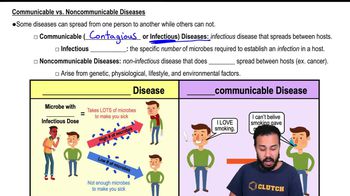
Communicable vs. Noncommunicable Diseases

Asymptomatic Carriers

Many people carry Neisseria meningitidis bacteria in their nasopharynx without symptoms, acting as reservoirs. In crowded settings, carriers can easily transmit the bacteria to others, facilitating outbreaks even when no one appears ill.
Recommended video:
Guided course
03:40
Electron Carrier NADPH

Host and Environmental Factors in Disease Spread

Factors such as stress, smoking, and poor ventilation in dormitories and barracks can weaken immune defenses and increase susceptibility. Additionally, close living quarters and shared facilities promote bacterial spread, explaining higher disease incidence in these populations.
Recommended video:
Guided course
07:21
Reviewing the Environmental Factors of Microbial Growth