
Ch. 21 - Rickettsias, Chlamydias, Spirochetes, and Vibrios
Bauman - Microbiology with Diseases by Taxonomy 6th Edition
Bauman6th EditionMicrobiology with Diseases by TaxonomyISBN: 9780134832302Not the one you use?Change textbook
Chapter 21, Problem 1

Suggest a hypothesis to explain why rickettsias are obligate parasites.

Verified step by step guidance
1
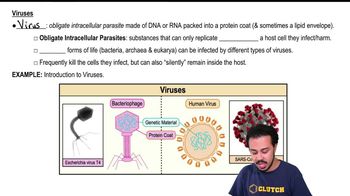
Understand the definition of obligate parasites: these are organisms that cannot complete their life cycle without exploiting a suitable host.
Recall that rickettsias are a group of bacteria that live inside the cells of their hosts, often causing diseases.
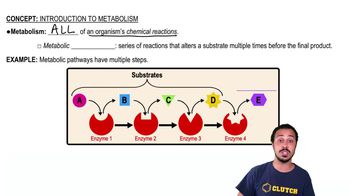
Consider the metabolic capabilities of rickettsias; they have reduced genomes and lack many genes necessary for independent survival and metabolism.
Formulate a hypothesis that rickettsias are obligate parasites because they rely on host cells to provide essential nutrients and energy sources that they cannot synthesize themselves.
Explain that this dependency on host cellular machinery and resources forces rickettsias to live exclusively inside host cells, making them obligate intracellular parasites.

Verified video answer for a similar problem:

This video solution was recommended by our tutors as helpful for the problem above.
Video duration:
3m
Was this helpful?

Key Concepts

Here are the essential concepts you must grasp in order to answer the question correctly.

Obligate Parasitism

Obligate parasites are organisms that cannot complete their life cycle without exploiting a suitable host. They rely entirely on the host's cellular machinery and resources for survival and reproduction, making independent life impossible.
Recommended video:

Rickettsia Biology and Metabolism

Rickettsias are small, Gram-negative bacteria with reduced genomes that lack many metabolic pathways. This genomic reduction forces them to depend on host cells for essential nutrients and energy, explaining their obligate intracellular lifestyle.
Recommended video:
Guided course
02:17
Introduction to Metabolism

Host-Pathogen Interaction

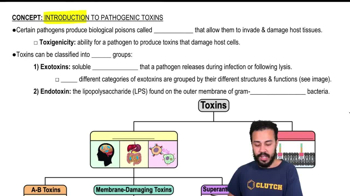
Rickettsias invade and live within host cells, often manipulating host processes to avoid immune detection and acquire nutrients. Understanding these interactions helps explain why they must reside inside host cells to survive and reproduce.
Recommended video:
Guided course
03:40
Introduction to Pathogenic Toxins