Ch. 21 - Rickettsias, Chlamydias, Spirochetes, and Vibrios
Bauman - Microbiology with Diseases by Taxonomy 6th Edition
Bauman6th EditionMicrobiology with Diseases by TaxonomyISBN: 9780134832302Not the one you use?Change textbook
Chapter 21, Problem 5

The most commonly reported sexually transmitted disease in the United States is caused ___________.
by the bacterium
a. Mycoplasma genitalium
b. Chlamydia trachomatis
c. Chlamydophila proctitis
d. Ureaplasma urealyticum

Verified step by step guidance
1
Step 1: Understand the question is asking for the bacterium responsible for the most commonly reported sexually transmitted disease (STD) in the United States.
Step 2: Recall that among the options, the bacterium Chlamydia trachomatis is well-known for causing chlamydia, which is the most frequently reported bacterial STD in the U.S.
Step 3: Review the other options: Mycoplasma genitalium, Chlamydophila proctitis, and Ureaplasma urealyticum are less commonly reported or less prevalent as causes of STDs compared to Chlamydia trachomatis.
Step 4: Confirm that Chlamydia trachomatis is the correct choice by considering epidemiological data and clinical significance in microbiology related to STDs.
Step 5: Select option b. Chlamydia trachomatis as the bacterium causing the most commonly reported STD in the United States.

Verified video answer for a similar problem:

This video solution was recommended by our tutors as helpful for the problem above.
Video duration:
1m
Was this helpful?

Key Concepts

Here are the essential concepts you must grasp in order to answer the question correctly.

Sexually Transmitted Diseases (STDs)

STDs are infections primarily spread through sexual contact. Understanding their epidemiology helps identify the most common pathogens responsible, which is crucial for diagnosis, treatment, and public health interventions.
Recommended video:
Guided course
04:57
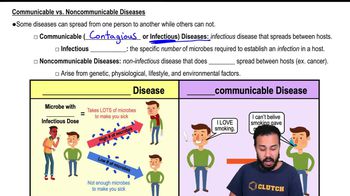
Communicable vs. Noncommunicable Diseases

Chlamydia trachomatis

Chlamydia trachomatis is a bacterial pathogen and the leading cause of bacterial sexually transmitted infections in the U.S. It often causes asymptomatic infections but can lead to serious reproductive complications if untreated.

Differentiation of Bacterial Pathogens in STDs

Recognizing the differences between bacteria like Mycoplasma genitalium, Chlamydophila species, and Ureaplasma urealyticum is essential for accurate diagnosis and treatment, as they vary in prevalence, symptoms, and antibiotic susceptibility.
Recommended video:
Guided course
03:27
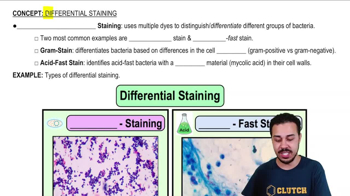
Differential Staining