Ch. 22 - Pathogenic Fungi
Bauman - Microbiology with Diseases by Taxonomy 6th Edition
Bauman6th EditionMicrobiology with Diseases by TaxonomyISBN: 9780134832302Not the one you use?Change textbook
Chapter 22, Problem 1

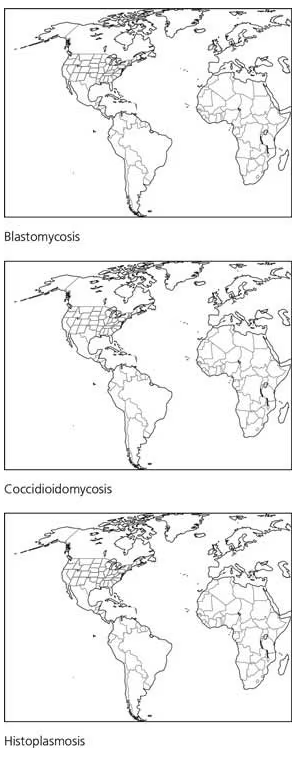
Color each map below to show the general area where each disease is endemic.
Three blank world maps labeled Blastomycosis, Coccidioidomycosis, and Histoplasmosis for coloring endemic disease areas.

Verified step by step guidance
1
Step 1: Understand the endemic regions for each disease. Blastomycosis is primarily found in the eastern United States and parts of Canada, especially around the Ohio and Mississippi River valleys and the Great Lakes region.
Step 2: For Blastomycosis, color the areas around the Ohio and Mississippi River valleys, the Great Lakes region, and parts of southeastern Canada on the first map.
Step 3: Coccidioidomycosis, also known as Valley fever, is endemic to the southwestern United States, particularly in California, Arizona, Nevada, New Mexico, Texas, and parts of northern Mexico.
Step 4: For Coccidioidomycosis, color the southwestern United States and northern Mexico regions on the second map.
Step 5: Histoplasmosis is commonly found in the Ohio and Mississippi River valleys, similar to Blastomycosis, but also extends into parts of Central and South America and Africa.
Step 6: For Histoplasmosis, color the Ohio and Mississippi River valleys on the third map, and also include parts of Central America and regions in Africa where the disease is known to be endemic.

Verified video answer for a similar problem:

This video solution was recommended by our tutors as helpful for the problem above.
Video duration:
2m
Was this helpful?

Key Concepts

Here are the essential concepts you must grasp in order to answer the question correctly.

Endemic Regions of Fungal Diseases

Endemic regions are geographic areas where specific diseases regularly occur. Understanding the endemic zones of fungal diseases like Blastomycosis, Coccidioidomycosis, and Histoplasmosis helps in diagnosis and epidemiology. These fungi thrive in particular environmental conditions, influencing their geographic distribution.
Recommended video:
Guided course
05:36
Stages of Infectious Disease Progression

Blastomycosis and Its Geographic Distribution

Blastomycosis is caused by Blastomyces dermatitidis, primarily found in moist soil and decomposing organic matter. It is endemic in the eastern and central United States, especially around the Ohio and Mississippi River valleys and the Great Lakes region. Recognizing this distribution aids in identifying potential exposure risks.
Recommended video:
Guided course
05:22
Types of Flagellar Distribution on Bacteria

Coccidioidomycosis and Histoplasmosis Distribution

Coccidioidomycosis, caused by Coccidioides species, is endemic in arid regions of the southwestern United States and parts of Mexico. Histoplasmosis, caused by Histoplasma capsulatum, is common in the Ohio and Mississippi River valleys. Both fungi are soil-associated, but their differing environmental preferences define their distinct endemic areas.
Recommended video:
Guided course
05:22
Types of Flagellar Distribution on Bacteria