Ch. 23 - Parasitic Protozoa, Helminths, and Arthropod Vectors
Bauman - Microbiology with Diseases by Taxonomy 6th Edition
Bauman6th EditionMicrobiology with Diseases by TaxonomyISBN: 9780134832302Not the one you use?Change textbook
Chapter 23, Problem 1

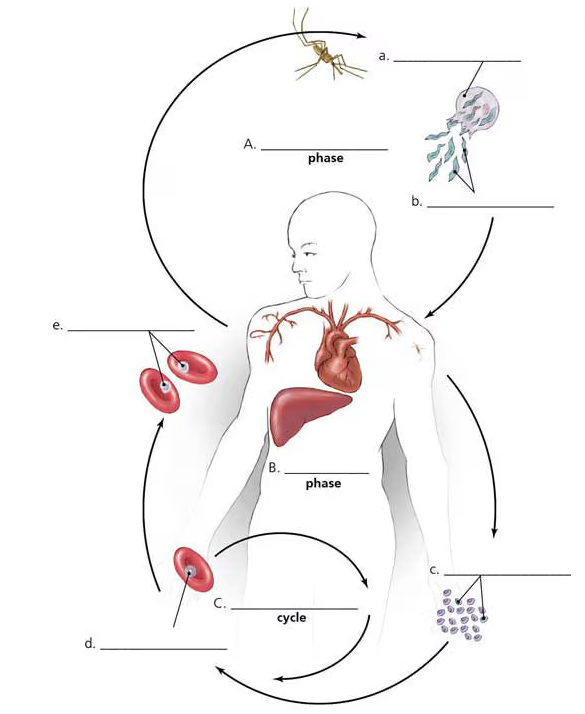
Label the three stages of the Plasmodium life cycle and label the forms of the parasite where indicated.
Diagram of Plasmodium life cycle showing mosquito and human phases with labeled parasite forms and infection stages.

Verified step by step guidance
1
Step 1: Identify the three main stages (phases) of the Plasmodium life cycle. These are typically the Mosquito phase (A), the Human liver phase (B), and the Human blood phase (C).
Step 2: Label the forms of the parasite in the mosquito phase (A). The form labeled 'a' is the sporozoite, which is injected into the human host by the mosquito. The form labeled 'b' is the oocyst, which develops in the mosquito's gut.
Step 3: Label the forms of the parasite in the human liver phase (B). The form labeled 'c' is the merozoite, which emerges from liver cells after the parasite multiplies inside hepatocytes.
Step 4: Label the forms of the parasite in the human blood phase (C). The form labeled 'd' is the trophozoite, which is the feeding stage inside red blood cells. The form labeled 'e' is the gametocyte, the sexual form that can be taken up by a mosquito to continue the cycle.
Step 5: Understand the flow of the life cycle: sporozoites enter the human bloodstream from the mosquito, infect liver cells and multiply into merozoites, which then infect red blood cells and develop into trophozoites and gametocytes. Gametocytes are taken up by mosquitoes to continue the cycle.

Verified video answer for a similar problem:

This video solution was recommended by our tutors as helpful for the problem above.
Video duration:
1m
Was this helpful?

Key Concepts

Here are the essential concepts you must grasp in order to answer the question correctly.

Plasmodium Life Cycle Stages

The Plasmodium life cycle includes three main stages: the sporogonic phase in the mosquito, the exoerythrocytic phase in the human liver, and the erythrocytic cycle in human red blood cells. Each stage involves different forms of the parasite and is crucial for transmission and disease progression.
Recommended video:

Forms of Plasmodium Parasite

Key forms of Plasmodium include sporozoites (infective form injected by mosquitoes), merozoites (released from liver cells to infect red blood cells), trophozoites (feeding stage inside red blood cells), and gametocytes (sexual forms taken up by mosquitoes). Recognizing these forms helps understand infection and transmission.
Recommended video:
Guided course
02:24
Protists:Protozoa

Transmission Between Mosquito and Human

Transmission occurs when an infected Anopheles mosquito injects sporozoites into a human during a blood meal. After development in the liver and red blood cells, gametocytes are taken up by another mosquito, continuing the cycle. This vector-host interaction is essential for malaria spread.
Recommended video:
Guided course
03:25
The Human Microbiome