Ch. 26 - Applied and Industrial Microbiology
Bauman - Microbiology with Diseases by Taxonomy 6th Edition
Bauman6th EditionMicrobiology with Diseases by TaxonomyISBN: 9780134832302Not the one you use?Change textbook
Chapter 26, Problem 1

Food fermentations do all of the following except ________.
a. Give foods a characteristic taste
b. Lower the risk of food spoilage
c. Sterilize foods
d. Increase the shelf life of the food

Verified step by step guidance
1
Understand the role of food fermentation: it involves the metabolic activity of microorganisms that transform food components, often producing acids, alcohols, and other compounds.
Analyze option (a): Fermentation produces characteristic flavors and aromas in foods, such as in yogurt, cheese, and sauerkraut, so this is a true function of fermentation.
Analyze option (b): Fermentation lowers the risk of spoilage by producing acids or alcohols that inhibit the growth of spoilage organisms, so this is also true.
Analyze option (c): Sterilization means complete destruction of all microorganisms, including spores, which fermentation does not achieve; fermentation reduces spoilage organisms but does not sterilize food.
Analyze option (d): Fermentation increases shelf life by creating conditions unfavorable to spoilage microbes, so this is true. Therefore, the exception is the process that fermentation does not perform, which is sterilization.

Verified video answer for a similar problem:

This video solution was recommended by our tutors as helpful for the problem above.
Video duration:
2m
Was this helpful?

Key Concepts

Here are the essential concepts you must grasp in order to answer the question correctly.

Food Fermentation

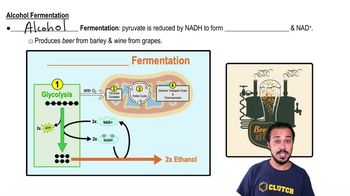
Food fermentation is a metabolic process where microorganisms like bacteria, yeasts, or molds convert sugars into acids, gases, or alcohol. This process alters the food's flavor, texture, and nutritional profile, often enhancing taste and preserving the food naturally.
Recommended video:
Guided course
02:02
Alcohol Fermentation

Food Preservation and Shelf Life

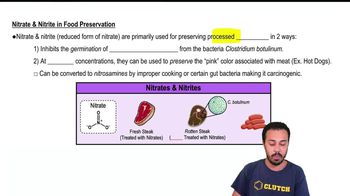
Fermentation helps preserve food by producing acids or alcohol that inhibit spoilage organisms, thereby extending the food's shelf life. This natural preservation reduces the risk of food spoilage and maintains food safety over time.
Recommended video:
Guided course
03:15
Nitrate & Nitrite in Food Preservation

Sterilization vs. Fermentation

Sterilization is a process that completely eliminates all microorganisms, including spores, usually by heat or chemicals. Fermentation does not sterilize food; instead, it encourages beneficial microbes while suppressing harmful ones, so fermented foods are not sterile.
Recommended video:
Guided course
02:02
Alcohol Fermentation