Ch. 27 - Microbial Ecology and Microbiomes
Bauman - Microbiology with Diseases by Taxonomy 6th Edition
Bauman6th EditionMicrobiology with Diseases by TaxonomyISBN: 9780134832302Not the one you use?Change textbook
Chapter 27, Problem 1

A microbiome is composed of _____.
a. single, pure populations
b. all organisms in a locale
c. all microbes in a location
d. only the bacteria are considered

Verified step by step guidance
1
Understand the term 'microbiome' which refers to the community of microorganisms living in a particular environment or location.
Recall that a microbiome includes various types of microbes such as bacteria, archaea, fungi, viruses, and sometimes protozoa, not just a single type or pure population.
Recognize that the microbiome is specific to microbes, so it does not include all organisms like plants or animals in a locale.
Eliminate options that suggest only bacteria are considered or that it refers to all organisms, focusing on the definition that includes all microbes in a location.
Conclude that the correct description of a microbiome is 'all microbes in a location,' which corresponds to option c.

Verified video answer for a similar problem:

This video solution was recommended by our tutors as helpful for the problem above.
Video duration:
2m
Was this helpful?

Key Concepts

Here are the essential concepts you must grasp in order to answer the question correctly.

Microbiome Definition

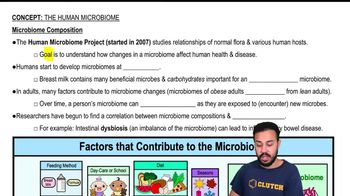
A microbiome refers to the community of microorganisms, including bacteria, viruses, fungi, and archaea, living in a specific environment. It encompasses all microbial life forms present in that location, not just a single species or group.
Recommended video:
Guided course
05:46
Microbiome Composition

Microbial Diversity

Microbial diversity highlights the variety of different microorganisms coexisting in an environment. This diversity includes multiple species and types of microbes, which interact and contribute to the ecosystem's function.
Recommended video:
Guided course
05:58
Nutritional Diversity Among Microbes

Distinction Between Microbiome and Macroorganisms

A microbiome specifically includes microbes, not all organisms in a locale. Larger organisms like plants and animals are excluded, focusing the term on microscopic life forms only.
Recommended video:
Guided course
05:46
Microbiome Composition