Ch. 3 - Cell Structure and Function
Bauman - Microbiology with Diseases by Taxonomy 6th Edition
Bauman6th EditionMicrobiology with Diseases by TaxonomyISBN: 9780134832302Not the one you use?Change textbook
Chapter 3, Problem 11

A Gram-negative cell is moving uric acid across the cytoplasmic membrane against its chemical gradient. Which of the following statements is true?


a. The exterior of the cell is probably electrically negative compared to the interior of the cell.
b. The acid probably moves by a passive means such as facilitated diffusion.
c. The acid moves by an active process such as active transport.
d. The movement of the acid requires phagocytosis.

Verified step by step guidance
1
Step 1: Understand the nature of the transport process described. The problem states that uric acid is moving across the cytoplasmic membrane against its chemical gradient, which means it is moving from a region of lower concentration to a region of higher concentration.
Step 2: Recall that moving a substance against its concentration gradient requires energy input, which is characteristic of active transport mechanisms, not passive transport.
Step 3: Evaluate the options: (a) concerns electrical charge differences, which may relate to membrane potential but does not directly explain movement against a chemical gradient; (b) suggests passive transport, which cannot move substances against their gradient; (c) suggests active transport, which fits the requirement of moving against the gradient; (d) involves phagocytosis, a process for engulfing large particles, not small molecules like uric acid.
Step 4: Conclude that the correct statement must describe an active process, since energy is needed to move uric acid against its chemical gradient.
Step 5: Therefore, the correct understanding is that the acid moves by an active process such as active transport.

Verified video answer for a similar problem:

This video solution was recommended by our tutors as helpful for the problem above.
Video duration:
3m
Was this helpful?

Key Concepts

Here are the essential concepts you must grasp in order to answer the question correctly.

Active Transport

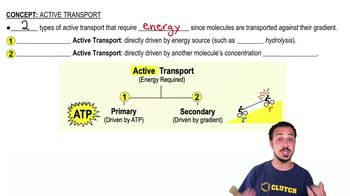
Active transport is the movement of molecules across a cell membrane against their concentration gradient, requiring energy input, often from ATP or proton motive force. This process allows cells to accumulate substances like uric acid even when their concentration is higher inside the cell.
Recommended video:
Guided course
02:37
Active Transport

Passive Transport and Facilitated Diffusion

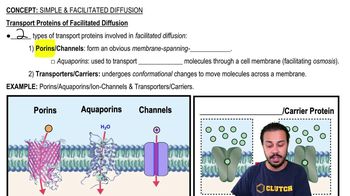
Passive transport involves the movement of molecules down their concentration gradient without energy expenditure. Facilitated diffusion uses membrane proteins to help molecules cross but cannot move substances against their gradient, making it unsuitable for moving uric acid uphill.
Recommended video:
Guided course
04:49
Transport Proteins of Facilitated Diffusion

Membrane Potential in Gram-negative Bacteria

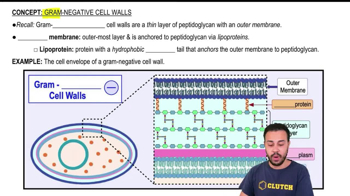
Gram-negative bacteria have an electrochemical gradient across their cytoplasmic membrane, typically with the inside being electrically negative relative to the outside. This membrane potential influences ion movement but does not alone drive molecules against their chemical gradient without energy.
Recommended video:
Guided course
3:04
Gram-Negative Cell Walls