Ch. 3 - Cell Structure and Function
Bauman - Microbiology with Diseases by Taxonomy 6th Edition
Bauman6th EditionMicrobiology with Diseases by TaxonomyISBN: 9780134832302Not the one you use?Change textbook
Chapter 3, Problem 1

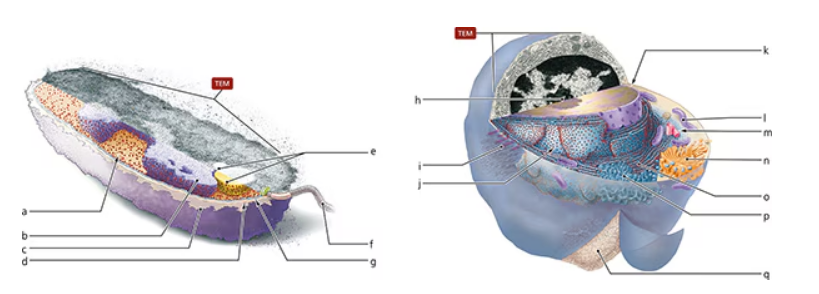
Label the structures of the following prokaryotic and eukaryotic cells. With a single word or short phrase, explain the function of each structure.

a.
b.
c.
d.
e.
f.
g.
h.
i.
j.
k.
l.
m.
n.
o.
p.
q.

Verified step by step guidance
1
Step 1: Identify the type of cells shown in the images. The left image represents a prokaryotic cell (likely a bacterium), and the right image represents a eukaryotic cell (animal cell).
Step 2: For the prokaryotic cell (left image), label each structure (a to g) by recognizing common prokaryotic features such as the cell wall, plasma membrane, cytoplasm, ribosomes, nucleoid, flagella, and pili. For example, the outermost layer is usually the cell wall, and the structure labeled 'f' is likely the flagellum used for motility.
Step 3: For the eukaryotic cell (right image), label each structure (h to q) by identifying organelles such as the nucleus, nucleolus, rough and smooth endoplasmic reticulum, Golgi apparatus, mitochondria, lysosomes, plasma membrane, and cytoskeleton. For example, the structure labeled 'k' is the nucleus, which contains genetic material.
Step 4: Explain the function of each labeled structure with a concise phrase. For example, the cell wall (prokaryote) provides structural support, the flagellum enables movement, the nucleus (eukaryote) stores DNA, the rough ER synthesizes proteins, and mitochondria generate energy.
Step 5: Organize your answers clearly by matching each label with its name and function, ensuring you use single words or short phrases for functions, such as 'protein synthesis,' 'energy production,' 'genetic storage,' or 'cell protection.'

Verified video answer for a similar problem:

This video solution was recommended by our tutors as helpful for the problem above.
Video duration:
3m
Was this helpful?

Key Concepts

Here are the essential concepts you must grasp in order to answer the question correctly.

Prokaryotic Cell Structure

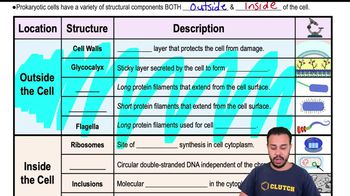
Prokaryotic cells lack a nucleus and membrane-bound organelles. Key structures include the cell wall for protection, plasma membrane for selective permeability, ribosomes for protein synthesis, and flagella for movement. Understanding these components helps identify their functions and differences from eukaryotic cells.
Recommended video:
Guided course
05:59
Overview of Prokaryotic Cell Structure

Eukaryotic Cell Organelles

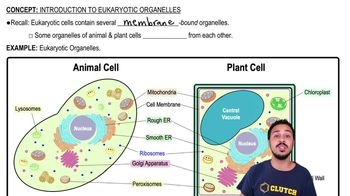
Eukaryotic cells contain membrane-bound organelles such as the nucleus (genetic control), endoplasmic reticulum (protein and lipid synthesis), Golgi apparatus (modification and packaging), mitochondria (energy production), and lysosomes (waste breakdown). Recognizing these organelles aids in explaining their specific cellular roles.
Recommended video:
Guided course
03:45
Introduction to Eukaryotic Organelles

Microscopy and Cell Imaging

Transmission Electron Microscopy (TEM) provides detailed images of cell ultrastructure, allowing visualization of internal components at high resolution. Understanding TEM helps interpret labeled cell diagrams and relate structural details to cellular functions in both prokaryotic and eukaryotic cells.
Recommended video:
Guided course
03:46
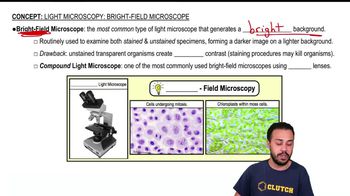
Light Microscopy: Bright-Field Microscopes
Related Practice
Textbook Question

Label each type of flagellar arrangement.

a. __________ <IMAGE> b. __________ <IMAGE>

c. __________ <IMAGE> d. __________ <IMAGE>

1154
views

Textbook Question

Match the terms with their descriptions following. Only one description is intended for each term.


 ____ Ribosome

 ____ Cytoskeleton

 ____ Centriole

 ____ Nucleus

 ____ Mitochondrion

 ____ Chloroplast

 ____ ER

 ____ Golgi body

 ____ Peroxisome


A. Site of protein synthesis

B. Contains enzymes to neutralize hydrogen peroxide

C. Functions as the transport system within a eukaryotic cell

D. Allows contraction of the cell

E. Site of most DNA in eukaryotes

F. Contains microtubules in "9 + 0" arrangement

G. Light-harvesting organelle

H. Packages large molecules for export from a cell

I. Its internal membranes are sites for ATP production

875
views
Textbook Question

Sketch, name, and describe three flagellar arrangements in bacteria.

1372
views
Textbook Question

A cell may allow a large or charged chemical to move across the cytoplasmic membrane, down the chemical’s electrical and chemical gradients, in a process called _________ .                   .


a. active transport

b. facilitated diffusion

c. endocytosis

d. pinocytosis

787
views
Textbook Question

Describe (or draw) an example of diffusion down a concentration gradient.

1297
views
Textbook Question

Match the structures with their descriptions following. A letter may be used more than once or not at all, and more than one letter may be correct for each blank.


  ____ Glycocalyx

  ____ Flagella

  ____ Axial filaments

 ____ Cilia

  ____ Fimbriae

  ____ Pili

  ____ Hami


A. Bristlelike projections found in quantities of 100 or more

B. Long whip

C. Responsible for conjugation

D. “Sweet cup” composed of polysaccharides and/or polypeptides

E. Numerous “grappling-hook” projections

F. Responsible for motility of spirochetes

G. Extensions not used for cell motility

H. Made of tubulin in eukaryotes

I. Made of flagellin in bacteria

1118
views