Ch. 5 - Microbial Metabolism
Bauman - Microbiology with Diseases by Taxonomy 6th Edition
Bauman6th EditionMicrobiology with Diseases by TaxonomyISBN: 9780134832302Not the one you use?Change textbook
Chapter 5, Problem 12

Which of the following statements best describes ribozymes?
a. Ribozymes are proteins that aid in the production of ribosomes.
b. Ribozymes are nucleic acids that produce ribose sugars.
c. Ribozymes store enzymes in ribosomes.
d. Ribozymes process RNA molecules in eukaryotes.

Verified step by step guidance
1
Step 1: Understand what ribozymes are. Ribozymes are RNA molecules that have catalytic activity, meaning they can act as enzymes to catalyze specific biochemical reactions.
Step 2: Review each option carefully in the context of ribozymes' function and nature:
- Option a suggests ribozymes are proteins, but ribozymes are actually RNA, not proteins.
- Option b claims ribozymes produce ribose sugars, but ribozymes do not synthesize sugars; they catalyze reactions involving RNA.
- Option c states ribozymes store enzymes in ribosomes, which is incorrect because ribozymes themselves are catalytic RNA, not storage molecules.
- Option d says ribozymes process RNA molecules in eukaryotes, which aligns with the known role of ribozymes in RNA splicing and processing.
Step 3: Conclude that the best description of ribozymes is that they are RNA molecules that catalyze the processing of RNA, especially in eukaryotic cells.

Verified video answer for a similar problem:

This video solution was recommended by our tutors as helpful for the problem above.
Video duration:
1m
Was this helpful?

Key Concepts

Here are the essential concepts you must grasp in order to answer the question correctly.

Ribozymes

Ribozymes are RNA molecules with catalytic activity, meaning they can act as enzymes to catalyze specific biochemical reactions, especially those involving RNA processing. Unlike protein enzymes, ribozymes are composed of nucleic acids and play key roles in RNA splicing and other RNA modifications.

RNA Processing in Eukaryotes

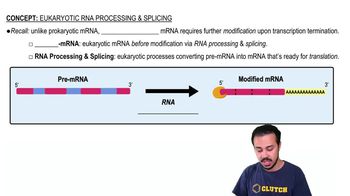
RNA processing involves modifications to the primary RNA transcript, such as splicing, capping, and polyadenylation, to produce mature RNA molecules. Ribozymes participate in some of these processes by catalyzing the removal of introns from pre-mRNA in eukaryotic cells.
Recommended video:
Guided course
02:32
Eukaryotic RNA Processing and Splicing

Difference Between Proteins and Nucleic Acids

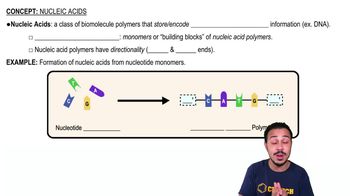
Proteins are polymers of amino acids that perform diverse functions including enzymatic catalysis, while nucleic acids like RNA and DNA store genetic information or perform catalytic roles. Ribozymes are unique because they are RNA molecules (nucleic acids) that function enzymatically, unlike typical protein enzymes.
Recommended video:
Guided course
03:22
Nucleic Acids