This bacteriophage DNA molecule has been warmed. Label the portions that likely have a higher ratio of GC base pairs and the portions that have a higher ratio of AT base pairs.
Ch. 7 - Microbial Genetics
Bauman6th EditionMicrobiology with Diseases by TaxonomyISBN: 9780134832302Not the one you use?Change textbook
Chapter 7, Problem 1
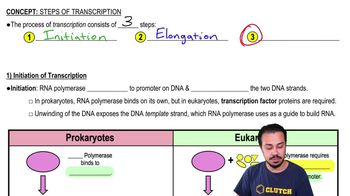
The three steps in RNA transcription are __________ , ___________ , and __________ .
Verified step by step guidance1
Identify the three main stages of RNA transcription, which describe the process by which RNA is synthesized from a DNA template.
The first step is called \(\textbf{initiation}\), where RNA polymerase binds to the promoter region of the DNA and begins to unwind the DNA strands.
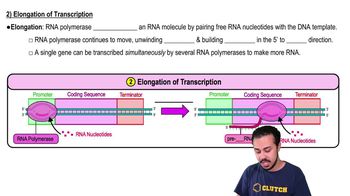
The second step is \(\textbf{elongation}\), during which RNA polymerase moves along the DNA template strand, adding complementary RNA nucleotides to the growing RNA chain.
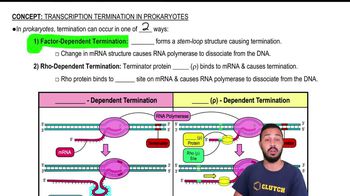
The third and final step is \(\textbf{termination}\), where RNA polymerase reaches a terminator sequence on the DNA, causing the RNA transcript to be released and the enzyme to detach from the DNA.
Summarize the three steps as: initiation, elongation, and termination.

Verified video answer for a similar problem:
This video solution was recommended by our tutors as helpful for the problem above.
Video duration:
2mWas this helpful?
Key Concepts
Here are the essential concepts you must grasp in order to answer the question correctly.
Initiation
Initiation is the first step of RNA transcription where RNA polymerase binds to the promoter region of the DNA, unwinding the double helix to begin RNA synthesis. This step determines the start site for transcription.
Recommended video:
Guided course
Initiation of Transcription
Elongation
During elongation, RNA polymerase moves along the DNA template strand, adding complementary RNA nucleotides to the growing RNA chain in a 5' to 3' direction, synthesizing the RNA transcript.
Recommended video:
Guided course
Elongation of Transcription
Termination
Termination is the final step where RNA polymerase reaches a specific sequence signaling the end of transcription, causing the RNA transcript to be released and the enzyme to detach from the DNA.
Recommended video:
Guided course
Transcription Termination in Prokaryotes
Related Practice
Textbook Question
1286
views
Textbook Question
On the accompanying figure, label:
DNA polymerase I, DNA polymerase III, helicase, lagging strand, leading strand, ligase, nucleotide (triphosphate), Okazaki fragment, primase, replication fork, RNA primer, and stabilizing proteins.
1625
views
Textbook Question
A triplet of mRNA nucleotides that specifies a particular amino acid is called a ____________ .
1429
views
Textbook Question
Which of the following is most likely the number of base pairs in a bacterial chromosome?
a. 4,000,000
b. 4000
c. 400
d. 40
1311
views
Textbook Question
How does the genotype of a bacterium determine its phenotype? Use the terms gene, mRNA, ribosome, and polypeptide in your answer.
1057
views