Ch. 7 - Microbial Genetics
Bauman - Microbiology with Diseases by Taxonomy 6th Edition
Bauman6th EditionMicrobiology with Diseases by TaxonomyISBN: 9780134832302Not the one you use?Change textbook
Chapter 7, Problem 20

Which of the following is not part of an operon?
a. Operator
b. Promoter
c. Origin
d. Gene

Verified step by step guidance
1
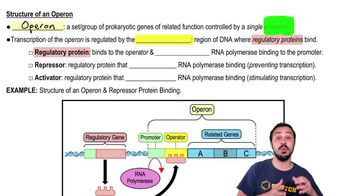
Step 1: Understand what an operon is. An operon is a functioning unit of genomic DNA containing a cluster of genes under the control of a single promoter, which are transcribed together into a single mRNA strand.
Step 2: Identify the components of an operon. Typically, an operon includes: the promoter (where RNA polymerase binds to start transcription), the operator (a regulatory sequence where repressors or activators bind), and structural genes (the genes that are transcribed).
Step 3: Review each option in the question: (a) operator, (b) promoter, (c) origin, and (d) gene. Determine which of these are parts of an operon based on the definition.
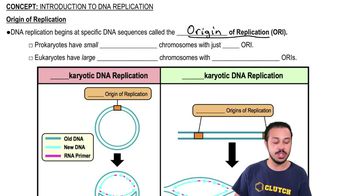
Step 4: Recall that the 'origin' refers to the origin of replication, a site where DNA replication begins, which is not part of an operon but rather part of the chromosome or plasmid replication machinery.
Step 5: Conclude that the component not part of an operon is the 'origin' because it is unrelated to the transcriptional regulation and gene expression controlled by an operon.

Verified video answer for a similar problem:

This video solution was recommended by our tutors as helpful for the problem above.
Video duration:
2m
Was this helpful?

Key Concepts

Here are the essential concepts you must grasp in order to answer the question correctly.

Operon Structure

An operon is a cluster of genes regulated together, typically found in prokaryotes. It includes a promoter, an operator, and one or more structural genes that are transcribed as a single mRNA. Understanding these components is essential to identify which elements belong to an operon.
Recommended video:
Guided course
04:23
Structure of an Operon

Promoter and Operator Functions

The promoter is a DNA sequence where RNA polymerase binds to initiate transcription, while the operator is a regulatory sequence that controls the access of RNA polymerase to the genes. Both are integral parts of an operon, coordinating gene expression.
Recommended video:
Guided course
06:04
Functional Groups

Origin of Replication

The origin of replication (ori) is a DNA sequence where replication begins, allowing the DNA to be copied. It is not part of an operon but is essential for DNA replication, distinguishing it from operon components involved in gene regulation.
Recommended video:
Guided course
03:33
Origin of Replication