
Ch. 8 - Recombinant DNA Technology
Bauman - Microbiology with Diseases by Taxonomy 6th Edition
Bauman6th EditionMicrobiology with Diseases by TaxonomyISBN: 9780134832302Not the one you use?Change textbook
Chapter 8, Problem 3

After scientists exposed cultures of Penicillium to agents X, Y, and Z, they examined the type and amount of penicillin produced by the altered fungi to find the one that is most effective. Agents X, Y, and Z were probably __________ .


a. recombinant cells
b. competent
c. mutagens
d. phages

Verified step by step guidance
1
Understand the context: Scientists exposed cultures of Penicillium to agents X, Y, and Z to observe changes in penicillin production. This implies the agents caused some alteration in the fungi.
Recall definitions: Recombinant cells are cells that have undergone genetic recombination, competent cells are able to take up foreign DNA, mutagens are agents that cause mutations or changes in the genetic material, and phages are viruses that infect bacteria.
Analyze the goal: Since the scientists are looking for changes in the type and amount of penicillin produced, the agents likely caused genetic changes in the fungi to alter penicillin synthesis.
Match the agents to their function: Agents that cause genetic changes to create variations in organisms are called mutagens.
Conclude that agents X, Y, and Z are most likely mutagens because they induce mutations that can affect penicillin production.

Verified video answer for a similar problem:

This video solution was recommended by our tutors as helpful for the problem above.
Video duration:
3m
Was this helpful?

Key Concepts

Here are the essential concepts you must grasp in order to answer the question correctly.

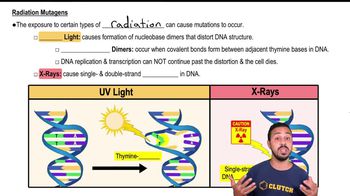
Mutagens

Mutagens are physical or chemical agents that cause changes or mutations in the DNA sequence of organisms. In microbiology, mutagens are used to induce genetic variations, which can lead to altered traits such as increased antibiotic production. Identifying mutagens helps understand how genetic changes affect microbial functions.
Recommended video:
Guided course
02:55
Radiation Mutagens

Penicillin Production in Penicillium

Penicillium is a genus of fungi known for producing penicillin, a natural antibiotic. The amount and type of penicillin produced can vary based on genetic and environmental factors. Studying how different agents affect penicillin synthesis is crucial for improving antibiotic yields.
Recommended video:
Guided course
01:16
Chemical Preservation of Perishable Products

Recombinant Cells vs. Competent Cells vs. Phages

Recombinant cells contain foreign DNA introduced through genetic engineering, competent cells are capable of taking up DNA from their environment, and phages are viruses that infect bacteria. These terms differ from mutagens, which directly cause mutations rather than facilitating DNA transfer or infection.
Recommended video:
Guided course
04:27
Review of Cytotoxic vs Helper T Cells