Ch. 1 - Introduction to Microbiology
Norman-McKay- Microbiology: Basic and Clinical Principles 2nd Edition
Norman-McKay2nd EditionMicrobiology: Basic and Clinical PrinciplesISBN: 9780137661619Not the one you use?Change textbook
Chapter 1, Problem 8

Assume that you isolated a unicellular, non-nucleated cell from a deep-sea vent. Select the statement that is least likely regarding the cell you found.
a. The cell is a prokaryote.
b. The cell is a fungus or yeast.
c. The cell is an archaea.
d. The cell is not a pathogen.
e. The cell is in Domain Archaea.

Verified step by step guidance
1
Step 1: Understand the key characteristics of the cell described: it is unicellular and non-nucleated. This means the cell lacks a true nucleus, which is a defining feature of prokaryotes.
Step 2: Recall that prokaryotes include bacteria and archaea, both of which are unicellular and lack a nucleus. Therefore, options stating the cell is a prokaryote or belongs to Domain Archaea are consistent with the description.
Step 3: Recognize that fungi and yeasts are eukaryotic organisms, meaning they have a true nucleus. Since the cell is non-nucleated, it cannot be a fungus or yeast, making option b unlikely.
Step 4: Consider the pathogenicity aspect: many prokaryotes, including archaea, are not pathogens, especially those from extreme environments like deep-sea vents. So, the statement that the cell is not a pathogen is plausible.
Step 5: Compare all options and identify the one that contradicts the fundamental characteristic of the cell (non-nucleated). The least likely statement is the one claiming the cell is a fungus or yeast, as these are nucleated eukaryotes.

Verified video answer for a similar problem:

This video solution was recommended by our tutors as helpful for the problem above.
Video duration:
1m
Was this helpful?

Key Concepts

Here are the essential concepts you must grasp in order to answer the question correctly.

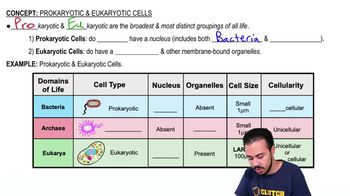
Prokaryotic vs. Eukaryotic Cells

Prokaryotic cells lack a nucleus and membrane-bound organelles, while eukaryotic cells have a defined nucleus. Unicellular, non-nucleated cells are prokaryotes, including bacteria and archaea, whereas fungi and yeasts are eukaryotic and contain nuclei.
Recommended video:
Guided course
05:54
Prokaryotic & Eukaryotic Cells

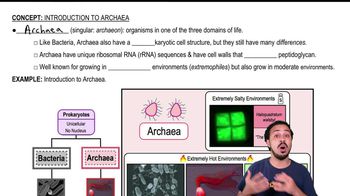
Characteristics of Archaea

Archaea are prokaryotic microorganisms often found in extreme environments like deep-sea vents. They have unique membrane lipids and genetic sequences distinct from bacteria, and they are classified in their own domain, separate from bacteria and eukaryotes.
Recommended video:
Guided course
04:39
Introduction to Archaea

Pathogenicity of Deep-Sea Microorganisms

Many microorganisms from extreme environments such as deep-sea vents are non-pathogenic to humans because they are adapted to harsh conditions unlike the human body. Pathogens typically thrive in or on hosts, so isolated extremophiles are less likely to be harmful.
Recommended video:
Guided course
01:25
Importance of Microorganisms
Related Practice