Ch. 1 - Introduction to Microbiology
Norman-McKay- Microbiology: Basic and Clinical Principles 2nd Edition
Norman-McKay2nd EditionMicrobiology: Basic and Clinical PrinciplesISBN: 9780137661619Not the one you use?Change textbook
Chapter 1, Problem 12

Label and describe the function of each indicated part of the compound light microscope.
<IMAGE>

Verified step by step guidance
1
Identify each labeled part of the compound light microscope in the image. Common parts include the eyepiece (ocular lens), objective lenses, stage, diaphragm, light source, coarse and fine focus knobs, and arm.
Describe the function of the eyepiece (ocular lens), which is to magnify the image formed by the objective lens, usually providing 10x magnification.
Explain the objective lenses, which are the primary lenses that magnify the specimen. They usually come in different magnifications (e.g., 4x, 10x, 40x, 100x) and can be rotated into place.
Describe the stage, which is the flat platform where the slide is placed. It often has clips to hold the slide steady during observation.
Explain the diaphragm (or iris diaphragm), which controls the amount of light that reaches the specimen, helping to improve contrast and resolution.

Verified video answer for a similar problem:

This video solution was recommended by our tutors as helpful for the problem above.
Video duration:
2m
Was this helpful?

Key Concepts

Here are the essential concepts you must grasp in order to answer the question correctly.

Parts of a Compound Light Microscope

A compound light microscope consists of several key parts including the eyepiece (ocular lens), objective lenses, stage, light source, diaphragm, and focus knobs. Each part plays a specific role in magnifying and viewing specimens clearly.
Recommended video:
Guided course
06:15
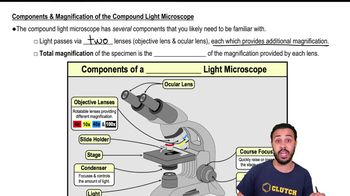
Components & Magnification of the Compound Light Microscope

Function of Objective and Ocular Lenses

The objective lenses, located near the specimen, provide primary magnification at different levels (e.g., 4x, 10x, 40x). The ocular lens further magnifies the image, usually by 10x, allowing detailed observation of microscopic structures.
Recommended video:
Guided course
06:04
Functional Groups

Role of Illumination and Focusing Mechanisms

The light source illuminates the specimen from below, while the diaphragm controls light intensity and contrast. Coarse and fine focus knobs adjust the distance between the objective lens and specimen to bring the image into sharp focus.
Recommended video:
Guided course
01:59
Introduction to Avoiding Host Defense Mechanisms
Related Practice
Textbook Question

Which of the following is/are true regarding our normal microbiota? Select all that apply.

a. Our normal microbiota is easily disrupted by hygiene practices like hand washing.

b. Our normal microbiota can include pathogens.

c. Normal microbiota compete with pathogens.

d. Normal microbiota may colonize us before we are even born.

e. Normal microbiota changes over time.

f. The normal microbiota that we have as adults is the same as we had as children.

g. The normal microbiota of the gut is similar to that of the skin.

1880
views
Textbook Question

A(n) ___________________ is a genetic variant of the same species.

1695
views
Textbook Question

___________________ are dormant structures that certain bacteria can make. These structures can be seen using the structural stain called the ___________________.

1547
views
Textbook Question

Fill in the blanks: In taxonomy, the broadest groupings are called ___________________, which are further subdivided into six different ___________________. The most specific or narrowest grouping is ___________________, which is the ___________________ name in the binomial nomenclature system.

1634
views
Textbook Question

Classify the following as bright field, dark field, phase contrast, or differential interference contrast (DIC).

a. Sample must be stained or have its own coloration to be seen:

b. Specimen is illuminated with polarized light:

c. Generates a falsely three-dimensional image:

d. The simplest and most common form of light microscopy:

e. Generates a negative image using a hollow cone of light:

f. Generates a negative image in which light shifts are converted into visible changes in brightness and contrast:

1365
views
Textbook Question

How is an opportunistic pathogen different from a pathogen?

2118
views