Ch. 12 - Adaptive Immunity
Norman-McKay- Microbiology: Basic and Clinical Principles 2nd Edition
Norman-McKay2nd EditionMicrobiology: Basic and Clinical PrinciplesISBN: 9780137661619Not the one you use?Change textbook
Chapter 12, Problem 12

Which of the following is not a function of antibodies?
a. Opsonization
b. Activating complement proteins
c. Activating T helper cells
d. Enhancing phagocytosis
e. Antigen neutralization

Verified step by step guidance
1
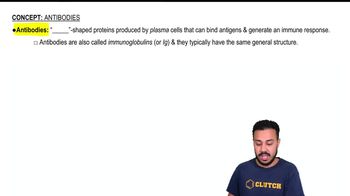
Step 1: Understand the role of antibodies in the immune system. Antibodies, also known as immunoglobulins, are proteins produced by B cells that specifically recognize and bind to antigens (foreign molecules). Their main functions include neutralizing pathogens, opsonization, activating complement proteins, and enhancing phagocytosis.
Step 2: Define each option in the context of antibody function: a) Opsonization is the process where antibodies coat pathogens to enhance their recognition and ingestion by phagocytes. b) Activating complement proteins involves antibodies triggering the complement cascade to destroy pathogens. c) Activating T helper cells refers to stimulating T helper cells, which is primarily a function of antigen-presenting cells, not antibodies. d) Enhancing phagocytosis is closely related to opsonization, where antibodies facilitate the engulfment of pathogens by phagocytes. e) Antigen neutralization is when antibodies bind to pathogens or toxins to block their harmful effects.
Step 3: Analyze which function is not directly performed by antibodies. While antibodies can bind antigens and activate complement or opsonize pathogens, the activation of T helper cells is generally mediated by antigen-presenting cells presenting processed antigen fragments to T cells, not by antibodies themselves.
Step 4: Conclude that the function 'activating T helper cells' is not a direct role of antibodies, distinguishing it from the other listed functions.
Step 5: Summarize that antibodies primarily function in neutralization, opsonization, complement activation, and enhancing phagocytosis, but do not directly activate T helper cells.

Verified video answer for a similar problem:

This video solution was recommended by our tutors as helpful for the problem above.
Video duration:
3m
Was this helpful?

Key Concepts

Here are the essential concepts you must grasp in order to answer the question correctly.

Functions of Antibodies

Antibodies are proteins produced by B cells that recognize and bind specific antigens. Their main functions include neutralizing pathogens, opsonization (marking pathogens for phagocytosis), activating the complement system, and enhancing phagocytosis to help clear infections.
Recommended video:

Complement System Activation

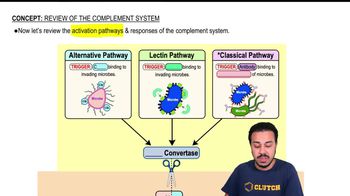
Antibodies, especially IgM and IgG, can activate the complement cascade by binding to antigens. This activation leads to pathogen lysis, inflammation, and enhanced phagocytosis, playing a crucial role in immune defense.
Recommended video:
Guided course
05:15
Review of the Complement System

Role of T Helper Cells in Immunity

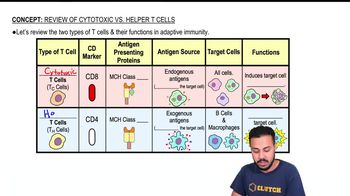
T helper cells are activated by antigen-presenting cells, not directly by antibodies. They coordinate immune responses by releasing cytokines that stimulate B cells and other immune cells, but antibodies themselves do not activate T helper cells.
Recommended video:
Guided course
04:27
Review of Cytotoxic vs Helper T Cells