
Ch. 13 - Immune System Disorders
Norman-McKay- Microbiology: Basic and Clinical Principles 2nd Edition
Norman-McKay2nd EditionMicrobiology: Basic and Clinical PrinciplesISBN: 9780137661619Not the one you use?Change textbook
Chapter 13, Problem 10

Which of the following is (are) true regarding type III hypersensitivity reactions? Select all that apply.
a. They involve IgG
b. They involve IgM
c. They are considered delayed reactions
d. They include autoimmune disorders like multiple sclerosis
e. They are rare compared with type I reactions

Verified step by step guidance
1
Step 1: Understand that type III hypersensitivity reactions are immune complex-mediated reactions. These involve the formation of antigen-antibody complexes, primarily with IgG antibodies, which deposit in tissues and cause inflammation.
Step 2: Recognize that IgG is the main antibody involved in type III hypersensitivity, so option (a) is true. IgM is generally not the primary antibody in these reactions, so option (b) is false.
Step 3: Know that type III hypersensitivity reactions are classified as delayed-type hypersensitivity because the immune complex deposition and resulting inflammation take several hours to days to develop, making option (c) true.
Step 4: Identify that autoimmune disorders like multiple sclerosis are typically associated with type IV hypersensitivity (cell-mediated), not type III. Therefore, option (d) is false.
Step 5: Understand that type III hypersensitivity reactions are not necessarily rare compared to type I reactions; both have distinct mechanisms and prevalence depending on the context, so option (e) is generally false.

Verified video answer for a similar problem:

This video solution was recommended by our tutors as helpful for the problem above.
Video duration:
1m
Was this helpful?

Key Concepts

Here are the essential concepts you must grasp in order to answer the question correctly.

Type III Hypersensitivity Reactions

Type III hypersensitivity involves immune complex formation where antigen-antibody complexes, primarily with IgG, deposit in tissues causing inflammation and damage. These reactions typically manifest hours to days after exposure and are distinct from immediate hypersensitivity types.
Recommended video:
Guided course
05:48
Types of Chemical Reactions

Role of Immunoglobulins in Hypersensitivity

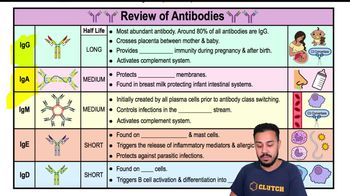
Different hypersensitivity types involve specific antibodies; Type III reactions mainly involve IgG antibodies forming immune complexes. IgM is less commonly involved in these reactions, while IgE is central to Type I hypersensitivity, highlighting the importance of antibody class in immune responses.
Recommended video:
Guided course
03:48
Review Table of Immunoglobin Classes

Clinical Manifestations and Examples of Type III Reactions

Type III hypersensitivity is associated with diseases like systemic lupus erythematosus and serum sickness, but not typically multiple sclerosis, which is a Type IV (cell-mediated) hypersensitivity. These reactions are more common than rare and are classified as delayed, occurring hours to days post antigen exposure.
Recommended video:
Guided course
05:48
Types of Chemical Reactions
Related Practice
Textbook Question

List the applicable hypersensitivities (type I, II, III, IV) as they relate to the description. Note, more than one type of hypersensitivity may be listed for a given description.

IgG antibodies can mediate type _________________hypersensitivities.

T cells mediate type _________________ hypersensitivities.

Type _________________ hypersensitivities may be generated in response to pharmaceutical drugs.

Type _________________ hypersensitivities may be associated with autoimmunity.

Type _________________ hypersensitivities require a sensitizing exposure.

IgE antibodies can mediate type _________________hypersensitivities.

1505
views
Textbook Question

Which of the following is the most likely to lead to graft-versushost disease?

a. An allogeneic bone marrow transplant

b. An allogeneic liver transplant

c. A xenogeneic heart valve transplant

d. An isogenic bone marrow transplant

e. A xenogeneic skin graft

1407
views
Textbook Question

Which patient would be the most likely to benefit from desensitization immunotherapy?

a. A person suffering from serum sickness

b. A person at risk for HDN during pregnancy

c. A person with an allergy to pollen

d. A transplant patient

e. An asthmatic patient

1111
views
Textbook Question

Imagine that one of your patients is an emergency medical technician who has a family history of autoimmune disorders and allergy, but she does not currently suffer from either. Which of the following is (are) most likely true of your patient? Select all that apply.

a. She is at an increased risk for cancer

b. She is at an increased risk for type I hypersensitivities

c. She is at an increased risk for type III hypersensitivities

d. She is at an increased risk for latex hypersensitivity

e. She is at an increased risk for immunosuppression

939
views
Textbook Question

Which types of white blood cells are most likely to be involved in type I hypersensitivities? Select all that apply.

a. T helper cells

b. T cytotoxic cells

c. Basophils

d. Macrophages

e. Mast cells

1077
views
Textbook Question

Which scenario presents the greatest risk for HDN developing?

a. O− mother with O+ fetus

b. A+ mother with O+ fetus

c. B−mother with AB− fetus

d. A−mother with O−fetus

e. AB+ mother with AB−fetus

1427
views