Ch. 15 - Antimicrobial Drugs
Norman-McKay- Microbiology: Basic and Clinical Principles 2nd Edition
Norman-McKay2nd EditionMicrobiology: Basic and Clinical PrinciplesISBN: 9780137661619Not the one you use?Change textbook
Chapter 15, Problem 15

Why is it challenging to obtain selectively toxic drugs against fungi, protozoans, and viruses?

Verified step by step guidance
1
Understand the concept of selective toxicity, which refers to a drug's ability to target and kill or inhibit a pathogen without harming the host's cells.
Recognize that fungi and protozoans are eukaryotic organisms, like human cells, meaning they share many cellular structures and metabolic pathways with the host, making it difficult to find drug targets unique to the pathogen.
Note that viruses are obligate intracellular parasites that use the host's cellular machinery to replicate, so targeting the virus without damaging host cells is inherently challenging.
Identify that the similarity between pathogen and host cells in fungi and protozoans reduces the number of unique biochemical pathways or structures that drugs can safely target, increasing the risk of toxicity.
Conclude that the challenge in developing selectively toxic drugs lies in finding molecular differences significant enough to exploit for treatment without causing harm to the host.

Verified video answer for a similar problem:

This video solution was recommended by our tutors as helpful for the problem above.
Video duration:
2m
Was this helpful?

Key Concepts

Here are the essential concepts you must grasp in order to answer the question correctly.

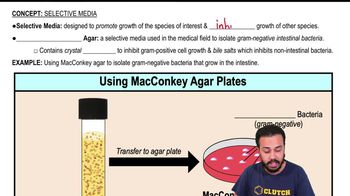
Selective Toxicity

Selective toxicity refers to a drug's ability to target and kill pathogens without harming the host's cells. Achieving this requires exploiting differences between the pathogen and host, such as unique metabolic pathways or structural components.
Recommended video:
Guided course
03:27
Selective Media

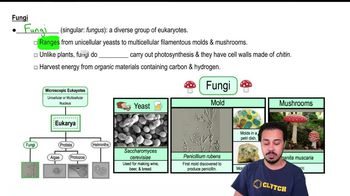
Eukaryotic Similarity of Fungi and Protozoans

Fungi and protozoans are eukaryotic organisms like human cells, sharing many cellular structures and metabolic processes. This similarity makes it difficult to find drug targets that affect the pathogen without also damaging host cells.
Recommended video:

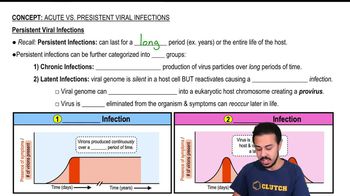
Viral Dependence on Host Machinery

Viruses rely heavily on host cellular machinery for replication and metabolism, lacking many unique structures of their own. This dependence limits the number of viral-specific targets, complicating the development of drugs that selectively inhibit viruses without host toxicity.
Recommended video:
Guided course
05:12
Persistent Viral Infections
Related Practice
Textbook Question

Mark the following as true or false, and then correct the false statements so they are true.

a. Human cells make drug efflux pumps.

b. The minimum bactericidal concentration is the minimum concentration of the drug that kills at least 50 percent of the bacteria present.

c. The E-test can reveal if a drug is bactericidal or bacteriostatic.

d. A drug that is bactericidal at one dose may be bacteriostatic at another dose.

e. The antifolate combination therapy trimethoprim-sulfamethoxazole may be used to treat protozoan infections.

766
views
Textbook Question

Acquired antibiotic resistance can include all of the following except:

a. Altering an enzyme that a given drug may target

b. Making endospores

c. Altering a point of entry for a drug

d. Making enzymes that inactivate a drug

e. Increasing the number of efflux pumps that are active in a cell

1401
views
Textbook Question

Which sensitivity test is best for determining the minimum bactericidal concentration and the minimum inhibitory concentration of a drug?

756
views
Textbook Question

Choose the false statement(s). Select all that apply.

a. Antifungal drugs may target cholesterol in fungal cell membranes.

b. Azole and polyene drugs promote cell lysis by impacting fungal cell plasma membranes.

c. Echinocandin drugs inhibit fungal cell wall synthesis.

d. Antifungal drugs may target DNA replication.

e. Antifungal drugs may target protein synthesis.

782
views
Textbook Question

If a gene encoding a bacterial transpeptidase enzyme undergoes mutation, which of the following antimicrobials may no longer be effective against the mutated bacterium?

a. Macrolides

b. Polypeptide drugs

c. Tetracyclines

d. Penicillins

e. Quinolones

754
views
Textbook Question

Match the antimicrobial drug to its feature. Some features may be used more than once, and some may not be used at all.

883
views