Ch. 17 - Skin and Eye Infections
Norman-McKay- Microbiology: Basic and Clinical Principles 2nd Edition
Norman-McKay2nd EditionMicrobiology: Basic and Clinical PrinciplesISBN: 9780137661619Not the one you use?Change textbook
Chapter 17, Problem 1

Which of the following is not considered a skin defense?
a. Perspiration
b. Melanin
c. Sebum
d. Lysosomes
e. Antimicrobial peptides

Verified step by step guidance
1
Step 1: Understand the role of each option in skin defense. Skin defenses are mechanisms that protect the body from microbial invasion.
Step 2: Analyze 'Perspiration' (sweat). It helps flush microbes from the skin surface and contains antimicrobial substances, so it is a skin defense.
Step 3: Consider 'Melanin'. It is a pigment that protects against UV radiation but does not directly defend against microbes, so it is not typically classified as a skin defense.
Step 4: Look at 'Sebum'. This oily substance helps maintain skin moisture and has antimicrobial properties, making it a skin defense.
Step 5: Evaluate 'Lysosomes' and 'Antimicrobial peptides'. Lysosomes are enzymes that break down bacterial cell walls and are present in secretions like sweat and tears, while antimicrobial peptides directly kill microbes; both are skin defenses.

Verified video answer for a similar problem:

This video solution was recommended by our tutors as helpful for the problem above.
Video duration:
2m
Was this helpful?

Key Concepts

Here are the essential concepts you must grasp in order to answer the question correctly.

Skin as a Physical and Chemical Barrier

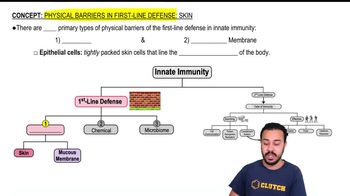
The skin acts as the body's first line of defense by providing a physical barrier that prevents pathogen entry. It also produces chemical substances like sebum and perspiration that inhibit microbial growth, maintaining skin integrity and protecting against infections.
Recommended video:
Guided course
01:28
Physical Barriers in First-Line Defenses: Skin

Role of Melanin

Melanin is a pigment responsible for skin color and protection against ultraviolet radiation. While it protects skin cells from UV damage, melanin does not have a direct antimicrobial or defensive role against pathogens on the skin surface.
Recommended video:
Guided course
01:25
Importance of Microorganisms

Antimicrobial Components of the Skin

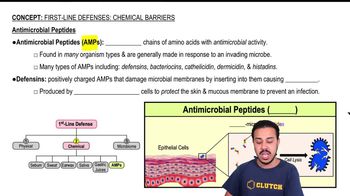
The skin produces antimicrobial peptides and enzymes like lysozyme that destroy or inhibit microbes. Perspiration contains lysozyme and other antimicrobial substances, while sebum creates an acidic environment unfavorable to many pathogens.
Recommended video:
Guided course
02:43
Antimicrobial Peptides