Ch. 2 - Biochemistry Basics
Norman-McKay- Microbiology: Basic and Clinical Principles 2nd Edition
Norman-McKay2nd EditionMicrobiology: Basic and Clinical PrinciplesISBN: 9780137661619Not the one you use?Change textbook
Chapter 2, Problem 3

Select all of the compounds from the following list. If it is not a compound, then state what it is.
a. H2O
b. HCO3-
c. O2
d. H2
e. Li2+
f. C6H12O6
g. H+

Verified step by step guidance
1
Step 1: Understand the definition of a compound. A compound is a substance formed when two or more different elements are chemically bonded together in fixed proportions.
Step 2: Analyze each item in the list to determine if it contains more than one type of element bonded together (compound) or if it is a molecule of a single element or an ion.
Step 3: For each item, identify the elements present: a. H2O contains hydrogen and oxygen (different elements) → compound; b. HCO3 contains hydrogen, carbon, and oxygen (different elements) → compound; c. O2 contains only oxygen atoms (same element) → molecule, not a compound; d. H2 contains only hydrogen atoms (same element) → molecule, not a compound; e. Li2+ is a lithium ion with a charge, consisting of only lithium atoms (same element) → ion, not a compound; f. C6H12O6 contains carbon, hydrogen, and oxygen (different elements) → compound; g. H+ is a hydrogen ion (single element) → ion, not a compound.
Step 4: Summarize the classification: compounds are those with multiple different elements chemically bonded; molecules of a single element are not compounds; ions are charged species and not compounds unless they contain multiple elements.
Step 5: Conclude by listing which are compounds and stating the nature of the others (molecule of single element or ion).

Verified video answer for a similar problem:

This video solution was recommended by our tutors as helpful for the problem above.
Video duration:
1m
Was this helpful?

Key Concepts

Here are the essential concepts you must grasp in order to answer the question correctly.

Definition of a Chemical Compound

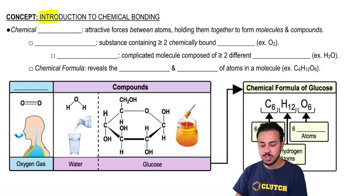
A chemical compound is a substance formed when two or more different elements chemically bond in fixed proportions. Compounds have unique properties distinct from their constituent elements. For example, H2O (water) is a compound made of hydrogen and oxygen atoms bonded together.
Recommended video:
Guided course
02:27
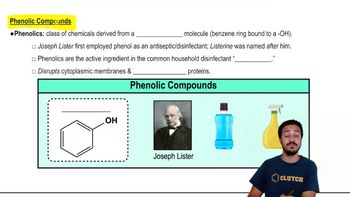
Phenolic Compounds

Difference Between Elements, Ions, and Molecules

Elements consist of only one type of atom, such as O2 (oxygen molecule) or H2 (hydrogen molecule). Ions are charged particles, like Li2+, which is a lithium ion with a positive charge. Molecules can be elements (O2) or compounds (H2O), depending on whether they contain one or multiple element types.
Recommended video:
Guided course
04:55
Types of Small Molecule Transport Review

Chemical Formulas and Their Interpretation

Chemical formulas represent the types and numbers of atoms in a substance. For example, HCO3 is the bicarbonate ion, not a neutral compound, while C6H12O6 is glucose, a compound with carbon, hydrogen, and oxygen. Understanding formulas helps identify whether a substance is a compound, element, or ion.
Recommended video:
Guided course
06:53
Introduction to Chemical Bonding