Ch. 3 - Introduction to Prokaryotic Cells
Norman-McKay- Microbiology: Basic and Clinical Principles 2nd Edition
Norman-McKay2nd EditionMicrobiology: Basic and Clinical PrinciplesISBN: 9780137661619Not the one you use?Change textbook
Chapter 3, Problem 12

Certain bacteria can form endospores in order to __________________.
a. Reproduce
b. Survive harsh conditions
c. Cause recurrent infections
d. Adhere to host tissues
e. Avoid the immune system of a host

Verified step by step guidance
1
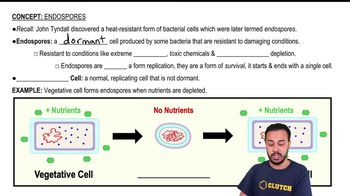
Understand what endospores are: Endospores are highly resistant, dormant structures formed by certain bacteria as a survival mechanism.
Recall the primary function of endospore formation: It is not for reproduction, but rather to protect the bacterial genetic material under unfavorable environmental conditions.
Evaluate each option based on the role of endospores:
a. Reproduce - Endospores are not involved in bacterial reproduction; bacteria reproduce by binary fission.
b. Survive harsh conditions - This aligns with the known function of endospores, which help bacteria endure extreme heat, desiccation, chemicals, and radiation.

Verified video answer for a similar problem:

This video solution was recommended by our tutors as helpful for the problem above.
Video duration:
2m
Was this helpful?

Key Concepts

Here are the essential concepts you must grasp in order to answer the question correctly.

Endospore Formation

Endospores are highly resistant, dormant structures formed by certain bacteria to survive extreme environmental stresses such as heat, desiccation, and chemicals. This process is not a means of reproduction but a survival strategy to protect the bacterial genome until favorable conditions return.
Recommended video:

Bacterial Survival Mechanisms

Bacteria employ various strategies to endure unfavorable conditions, including forming endospores, producing biofilms, and entering dormant states. Endospore formation is unique because it allows bacteria to withstand extreme environments that would normally kill vegetative cells.
Recommended video:
Guided course
04:18
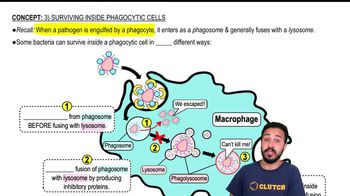
Surviving Inside Phagocytic Cells

Difference Between Reproduction and Survival

Reproduction in bacteria typically occurs through binary fission, producing new cells. Endospore formation, however, is not reproductive; it is a protective response. Understanding this distinction helps clarify why endospores are formed to survive, not to increase bacterial numbers.
Recommended video:
Guided course
04:18
Surviving Inside Phagocytic Cells