Ch. 4 - Introduction to Eukaryotic Cells
Norman-McKay- Microbiology: Basic and Clinical Principles 2nd Edition
Norman-McKay2nd EditionMicrobiology: Basic and Clinical PrinciplesISBN: 9780137661619Not the one you use?Change textbook
Chapter 4, Problem 3

Indicate the true statements about eukaryotic cells and then reword the false statements so that they are true.
a. Eukaryotic cells have 70S ribosomes on the rough endoplasmic reticulum.
b. Eukaryotic cells sexually reproduce by mitosis.
c. Eukaryotic cells can make up unicellular or multicellular organisms.
d. Eukaryotic cells always have a cell wall.
e. Eukaryotic cells can be photosynthetic.
f. Eukaryotic cells use fimbriae for motility.
g. Yeast is a multicellular eukaryote.

Verified step by step guidance
1
Step 1: Analyze statement (a): "Eukaryotic cells have 70S ribosomes on the rough endoplasmic reticulum." Recall that eukaryotic cells have 80S ribosomes in the cytoplasm and on the rough ER, while 70S ribosomes are characteristic of prokaryotes and mitochondria/chloroplasts. Determine if this statement is true or false and, if false, reword it correctly.
Step 2: Analyze statement (b): "Eukaryotic cells sexually reproduce by mitosis." Understand the difference between mitosis and meiosis. Mitosis is for asexual reproduction and cell division, while meiosis is involved in sexual reproduction. Decide if this statement is true or false and rephrase it if needed.
Step 3: Analyze statement (c): "Eukaryotic cells can make up unicellular or multicellular organisms." Consider examples like protists (unicellular) and animals/plants (multicellular) to verify this statement's accuracy.
Step 4: Analyze statement (d): "Eukaryotic cells always have a cell wall." Recall which eukaryotes have cell walls (plants, fungi) and which do not (animal cells). Determine the truth of this statement and correct it if false.
Step 5: Analyze statements (e), (f), and (g): For (e) "Eukaryotic cells can be photosynthetic," consider plants and algae; for (f) "Eukaryotic cells use fimbriae for motility," recall that fimbriae are bacterial structures, not eukaryotic; for (g) "Yeast is a multicellular eukaryote," remember yeast is unicellular. Identify which are true and reword the false statements accordingly.

Verified video answer for a similar problem:

This video solution was recommended by our tutors as helpful for the problem above.
Video duration:
2m
Was this helpful?

Key Concepts

Here are the essential concepts you must grasp in order to answer the question correctly.

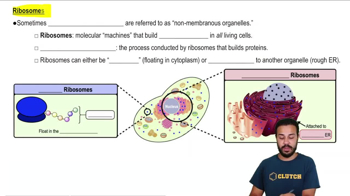
Ribosome Types in Eukaryotic Cells

Eukaryotic cells contain 80S ribosomes in the cytoplasm and on the rough endoplasmic reticulum, which are larger than the 70S ribosomes found in prokaryotes and mitochondria. This distinction is important for understanding protein synthesis and antibiotic targeting.
Recommended video:
Guided course
05:51
Eukaryotic Ribosomes

Cell Reproduction in Eukaryotes

Eukaryotic cells reproduce sexually through meiosis, which reduces chromosome number by half, and asexually through mitosis, which produces genetically identical daughter cells. Sexual reproduction involves the fusion of gametes, not mitosis.
Recommended video:
Guided course
04:17
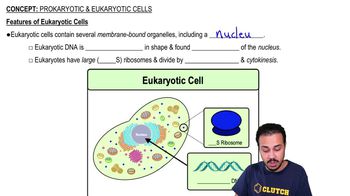
Features of Eukaryotic Cells

Cell Wall Presence and Function in Eukaryotes

Not all eukaryotic cells have a cell wall; it is present in plants, fungi, and some protists but absent in animal cells. The cell wall provides structural support and protection, differing in composition among groups, such as cellulose in plants and chitin in fungi.
Recommended video:
Guided course
05:42
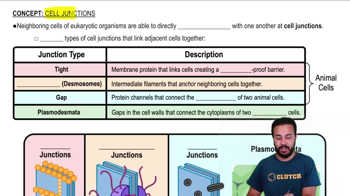
Cell Junctions