Ch. 6 - Viruses and Prions
Norman-McKay- Microbiology: Basic and Clinical Principles 2nd Edition
Norman-McKay2nd EditionMicrobiology: Basic and Clinical PrinciplesISBN: 9780137661619Not the one you use?Change textbook
Chapter 6, Problem 1

An RNA virus with an antisense or negative strand must have which of the following enzymes to replicate?
a. Reverse transcriptase
b. Host DNA polymerase
c. RNA-dependent RNA polymerase
d. Host RNA polymerase

Verified step by step guidance
1
Understand the nature of the virus's genome: an RNA virus with an antisense (negative) strand means its RNA is complementary to the mRNA that can be translated into proteins.
Recall that for replication, the virus must produce a positive-sense RNA strand (mRNA) from its negative-sense RNA template.
Identify the enzyme responsible for synthesizing RNA from an RNA template, which is not typically found in host cells because host cells usually transcribe RNA from DNA, not RNA from RNA.
Recognize that this enzyme is called RNA-dependent RNA polymerase, which synthesizes a complementary RNA strand from an RNA template.
Conclude that the virus must carry or encode RNA-dependent RNA polymerase to replicate its genome and produce mRNA for protein synthesis.

Verified video answer for a similar problem:

This video solution was recommended by our tutors as helpful for the problem above.
Video duration:
2m
Was this helpful?

Key Concepts

Here are the essential concepts you must grasp in order to answer the question correctly.

Antisense (Negative) Strand RNA Virus

An antisense or negative strand RNA virus has a genome complementary to the mRNA needed for protein synthesis. It cannot be directly translated by host ribosomes and must first produce a positive-sense RNA strand to serve as mRNA for viral protein production.
Recommended video:
Guided course
04:28
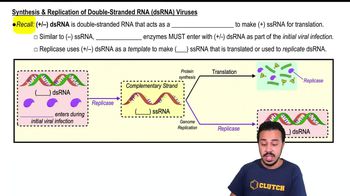
Replication of Double-Stranded RNA Viruses

RNA-dependent RNA Polymerase

RNA-dependent RNA polymerase is a viral enzyme that synthesizes RNA from an RNA template. Negative strand RNA viruses carry or encode this enzyme to transcribe their genome into a positive-sense RNA strand, enabling translation and replication.
Recommended video:
Guided course
04:19
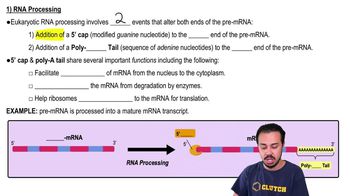
1) RNA Processing

Role of Host Enzymes in Viral Replication

Host DNA and RNA polymerases typically do not replicate RNA viruses directly, especially negative strand RNA viruses. These viruses rely on their own RNA-dependent RNA polymerase rather than host enzymes like DNA polymerase or RNA polymerase for genome replication.
Recommended video:
Guided course
04:26
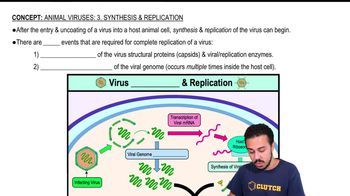
Animal Viruses: 3. Synthesis & Replication