

Ch. 7 - Fundamentals of Microbial Growth
Norman-McKay- Microbiology: Basic and Clinical Principles 2nd Edition
Norman-McKay2nd EditionMicrobiology: Basic and Clinical PrinciplesISBN: 9780137661619Not the one you use?Change textbook
Chapter 7, Problem 18

Which of the following is (are) true? Select all that apply.
a. Scalpels are critical equipment.
b. Endoscopes are noncritical equipment.
c. Stethoscopes are noncritical equipment.
d. Anesthesia tubing is semicritical equipment.
e. Critical equipment contacts intact skin.

Verified step by step guidance
1
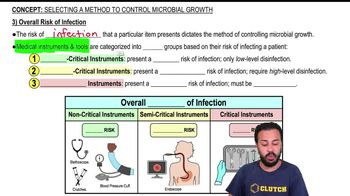
Step 1: Understand the classification of medical equipment based on the Spaulding classification system, which divides equipment into critical, semicritical, and noncritical categories depending on the risk of infection and the type of contact with the patient.
Step 2: Recall that critical equipment are items that enter sterile tissue or the vascular system and must be sterile because they pose a high risk of infection. Examples include scalpels and surgical instruments.
Step 3: Recognize that semicritical equipment contacts mucous membranes or non-intact skin and requires high-level disinfection. Anesthesia tubing is an example of semicritical equipment.
Step 4: Identify noncritical equipment as items that contact intact skin but not mucous membranes or sterile body areas, such as stethoscopes. Endoscopes, however, contact mucous membranes and are therefore semicritical, not noncritical.
Step 5: Evaluate each statement based on these definitions: (a) scalpels are critical, (b) endoscopes are semicritical (not noncritical), (c) stethoscopes are noncritical, (d) anesthesia tubing is semicritical, and (e) critical equipment contacts sterile tissue, not just intact skin.

Verified video answer for a similar problem:

This video solution was recommended by our tutors as helpful for the problem above.
Video duration:
1m
Was this helpful?

Key Concepts

Here are the essential concepts you must grasp in order to answer the question correctly.

Classification of Medical Equipment by Infection Risk

Medical equipment is classified as critical, semicritical, or noncritical based on the risk of infection transmission. Critical items contact sterile body areas and must be sterile. Semicritical items contact mucous membranes or non-intact skin and require high-level disinfection. Noncritical items contact intact skin and need low-level disinfection or cleaning.
Recommended video:
Guided course
04:52
Overall Risk of Infection

Examples of Equipment in Each Category

Critical equipment includes items like scalpels that penetrate sterile tissue. Semicritical equipment includes devices such as anesthesia tubing that contact mucous membranes. Noncritical equipment includes items like stethoscopes that only touch intact skin, posing the lowest infection risk.
Recommended video:
Guided course
05:48
Categorizing Life Based on Energy Acquisition

Importance of Proper Disinfection and Sterilization

Proper cleaning, disinfection, or sterilization of medical equipment prevents healthcare-associated infections. Critical items require sterilization, semicritical items need high-level disinfection, and noncritical items require low-level disinfection or cleaning. Understanding these protocols ensures patient safety.
Recommended video:
Guided course
01:25
Importance of Microorganisms