Ch. 7 - Fundamentals of Microbial Growth
Norman-McKay- Microbiology: Basic and Clinical Principles 2nd Edition
Norman-McKay2nd EditionMicrobiology: Basic and Clinical PrinciplesISBN: 9780137661619Not the one you use?Change textbook
Chapter 7, Problem 12

You have a patient who is suffering from a Clostridioides difficile infection. Which of the following would most likely be recommended to decontaminate small heat-stable equipment used for the patient?
a. Autoclave all equipment at 121°C for 15 minutes.
b. Boil equipment for 3 minutes.
c. Place the equipment in a hot-air oven at 121°C for 15 minutes.
d. Treat all equipment with a detergent solution.
e. None of the above.

Verified step by step guidance
1
Step 1: Understand the nature of Clostridioides difficile spores, which are known to be highly resistant to heat and many common disinfectants, making decontamination challenging.
Step 2: Recognize that boiling (100°C) for a few minutes is generally insufficient to kill C. difficile spores because spores can survive boiling temperatures.
Step 3: Consider that autoclaving at 121°C for 15 minutes uses pressurized steam, which is effective in sterilizing and killing heat-resistant spores, including those of C. difficile.
Step 4: Note that hot-air ovens require higher temperatures and longer times to achieve sterilization compared to autoclaving, and 121°C for 15 minutes in a hot-air oven is not sufficient for spore destruction.
Step 5: Understand that detergent solutions do not kill spores; they only remove dirt and microbes but do not sterilize equipment contaminated with C. difficile spores.

Verified video answer for a similar problem:

This video solution was recommended by our tutors as helpful for the problem above.
Video duration:
1m
Was this helpful?

Key Concepts

Here are the essential concepts you must grasp in order to answer the question correctly.

Clostridioides difficile and its spores

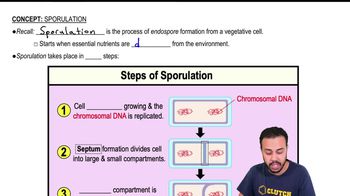
Clostridioides difficile is a bacterium that forms highly resistant spores, which can survive harsh conditions including heat and disinfectants. These spores are the main cause of infection transmission and require specific sterilization methods to be effectively eliminated from medical equipment.
Recommended video:

Heat resistance and sterilization methods

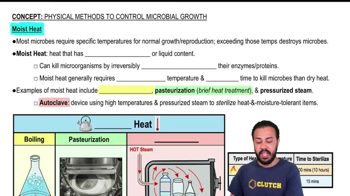
Different sterilization techniques vary in their ability to kill microorganisms and spores. Autoclaving uses moist heat under pressure and is highly effective against spores, while boiling and dry heat ovens may not reliably destroy heat-resistant spores like those of C. difficile.
Recommended video:

Decontamination of heat-stable medical equipment

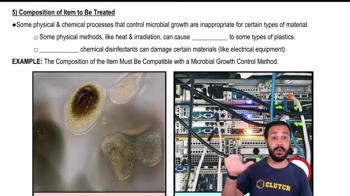
For small heat-stable equipment contaminated with C. difficile spores, autoclaving at 121°C for at least 15 minutes is the recommended method. This ensures complete sterilization, unlike boiling or detergent cleaning, which are insufficient to eliminate spores.
Recommended video:
Guided course
02:16
Composition of Item to Be Treated
Related Practice
Textbook Question

If you were a manufacturer of electronic pacemakers for heart implantation, which agent would you most likely use to treat your product?

a. Ethanol

b. Iodophor

c. Glutaraldehyde

d. Autoclave

e. Ethylene oxide

927
views
Textbook Question

You are collecting a clinical sample for microbiological analysis. Which of the following is the most important thing you must do?

a. Follow aseptic protocols.

b. Refrigerate the samples immediately after collection.

c. Determine if the potential pathogen is an aerobe or strict anaerobe.

d. Determine if normal flora have been removed before the sample is collected.

935
views
Textbook Question

_____________ microbes use oxygen in metabolism, while _____________ do not.

1044
views
Textbook Question

Match the term to the proper description(s). A term can have more than one description.

765
views
Textbook Question

Label each statement that follows as true or false, and correct the false statements so they are true:

a. Most pathogens would be considered mesophilic alkaliphiles.

b. Sterilization is a form of decontamination.

c. Disinfection is a form of decontamination.

d. High-level germicides achieve sterilization.

e. Ionizing radiation is a form of chemical microbial control.

f. Standard pasteurization is a way to sterilize milk.

1002
views
Textbook Question

Choose the false statement about turbidity as an enumeration method.

a. It is an indirect enumeration method.

b. It is performed using a spectrophotometer.

c. It must be done using a liquid culture.

d. It differentiates between live and dead cells.

e. It is a rapid enumeration method.

1301
views