Ch. 8 - Microbial Metabolism
Norman-McKay- Microbiology: Basic and Clinical Principles 2nd Edition
Norman-McKay2nd EditionMicrobiology: Basic and Clinical PrinciplesISBN: 9780137661619Not the one you use?Change textbook
Chapter 8, Problem 3

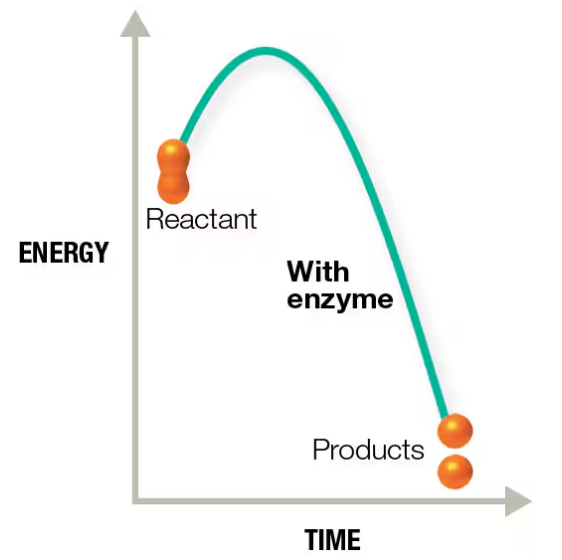
The graph shows an enzyme-catalyzed reaction.
a. Draw a line that would correspond to a noncatalyzed reaction.
b. Is this an endergonic or exergonic reaction? How can you tell?
c. Label the point on your graph that corresponds with the activation energy.
Graph showing energy changes over time in an enzyme-catalyzed reaction from reactants to products with lowered activation energy.

Verified step by step guidance
1
Step 1: Understand the difference between catalyzed and noncatalyzed reactions. In an enzyme-catalyzed reaction, the enzyme lowers the activation energy, so the graph shows a lower peak compared to a noncatalyzed reaction. To draw the line for a noncatalyzed reaction, sketch a curve with a higher peak (activation energy) but the same starting and ending energy levels as the catalyzed reaction.
Step 2: Determine if the reaction is endergonic or exergonic by comparing the free energy of reactants and products. If the products have lower free energy than the reactants, the reaction releases energy and is exergonic. If the products have higher free energy, it requires energy input and is endergonic.
Step 3: Identify the activation energy on the graph. Activation energy is the energy difference between the reactants and the highest point (peak) on the curve. Label this vertical distance on the graph as the activation energy.
Step 4: Note that the enzyme lowers the activation energy by stabilizing the transition state, which is why the catalyzed reaction curve has a lower peak compared to the noncatalyzed reaction.
Step 5: Remember that the overall change in free energy (ΔG) between reactants and products remains the same whether the reaction is catalyzed or not; the enzyme only affects the activation energy, not the thermodynamics of the reaction.

Verified video answer for a similar problem:

This video solution was recommended by our tutors as helpful for the problem above.
Video duration:
3m
Was this helpful?

Key Concepts

Here are the essential concepts you must grasp in order to answer the question correctly.

Enzyme Catalysis and Activation Energy

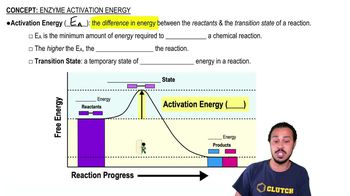
Enzymes speed up chemical reactions by lowering the activation energy, which is the energy barrier that must be overcome for reactants to convert into products. This results in a faster reaction rate without altering the overall energy change of the reaction.
Recommended video:
Guided course
04:18
Enzyme Activation Energy

Endergonic vs. Exergonic Reactions

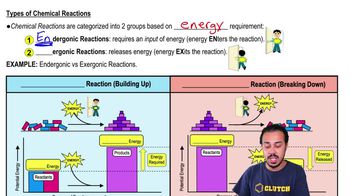
Exergonic reactions release energy and have a negative Gibbs free energy change (ΔG), while endergonic reactions require energy input and have a positive ΔG. The direction of energy flow can be inferred from the relative energy levels of reactants and products on the graph.
Recommended video:
Guided course
05:48
Types of Chemical Reactions

Interpreting Reaction Energy Graphs

Reaction energy graphs plot the energy of reactants and products over the course of a reaction. Key features include the activation energy peak and the difference in energy between reactants and products, which helps identify the reaction type and the effect of catalysts.
Recommended video:
Guided course
04:18
Enzyme Activation Energy