Ch. 5 - Genetics
Norman-McKay- Microbiology: Basic and Clinical Principles 2nd Edition
Norman-McKay2nd EditionMicrobiology: Basic and Clinical PrinciplesISBN: 9780137661619Not the one you use?Change textbook
Chapter 5, Problem 5.4

During ___________ a pilus forms between an F+ and an Fcell and allows for the exchange of genetic material. By the end of the process, the previously F cell is converted to a(n) ___________ cell.

Verified step by step guidance
1
Identify the process described: The formation of a pilus between an F+ and an F− cell for genetic material exchange is characteristic of bacterial conjugation.
Understand the role of the pilus: During conjugation, the pilus acts as a bridge that connects the donor (F+) cell to the recipient (F−) cell, allowing transfer of genetic material, specifically the F plasmid.
Recognize the nature of the cells involved: The F+ cell contains the fertility factor (F plasmid), while the F− cell lacks it initially.
Describe the outcome of the process: After conjugation, the F− cell receives a copy of the F plasmid through the pilus, which converts it into an F+ cell.
Summarize the blanks: The first blank is filled by the term 'conjugation', and the second blank is filled by 'F+' to indicate the conversion of the recipient cell.

Verified video answer for a similar problem:

This video solution was recommended by our tutors as helpful for the problem above.
Video duration:
2m
Was this helpful?

Key Concepts

Here are the essential concepts you must grasp in order to answer the question correctly.

Bacterial Conjugation

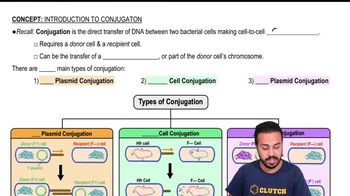
Bacterial conjugation is a process where genetic material is transferred directly between bacterial cells through physical contact. It involves the formation of a pilus that connects an F+ donor cell to an F− recipient cell, enabling the transfer of plasmid DNA.
Recommended video:
Guided course
04:21
Introduction to Conjugation

F Plasmid and F+ / F− Cells

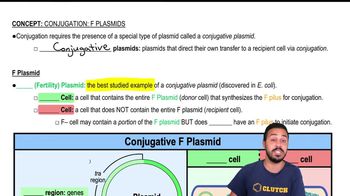
The F plasmid (fertility plasmid) carries genes that allow bacteria to form a pilus and initiate conjugation. Cells with the F plasmid are called F+ and can donate DNA, while F− cells lack the plasmid and act as recipients during conjugation.
Recommended video:

Conversion of F− to F+ Cell

During conjugation, the F plasmid is replicated and transferred from the F+ donor to the F− recipient. After receiving the plasmid, the F− cell becomes F+, gaining the ability to form pili and transfer DNA to other cells.
Recommended video:
Guided course
04:31
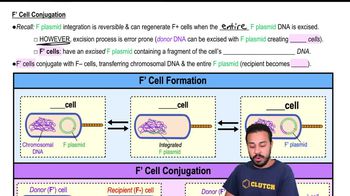
F’ Cell Conjugation
Related Practice
Textbook Question

Codons are ___________ nucleotides long and are in ___________, which is transcribed from DNA. During ___________, tRNAs serve as adapter molecules to bring ___________ to the ribosome to build a protein. Once the ribosome reaches a(n) ___________ on the mRNA, translation ends.

1258
views
Textbook Question

Match the following:

1258
views
Textbook Question

Label the following as a biological, chemical, or physical mutagen:

UV radiation:

Transposons:

Cigarette smoke:

Viruses:

X-rays:

Plasmids:

Alcohol:

1464
views
Textbook Question

Select the false statement:

a. DNA is made of deoxyribonucleotides.

b. RNA is made of ribonucleotides.

c. RNA is built in a 5' to 3' direction.

d. DNA is built in a 5' to 3' direction.

e. RNA primase builds RNA in transcription.

1237
views
Textbook Question

Indicate the true statements and then correct the false statements so that they are true.

a. DNA is replicated in a 3' to 5' direction.

b. DNA has a parallel arrangement.

c. RNA primase is required on the leading and the lagging strand.

d. DNA ligase forms phosphodiester bonds between Okazaki fragments on the lagging strand.

e. Prokaryotic mRNA requires processing before it is translated.

f. In RNA, A bonds to U.

g. In DNA, C bonds with G.

h. RNA contains deoxyribonucleotides.

815
views
Textbook Question

Assume you have the DNA sequence 3'-ACGTATCCAGCAGCTCCACCAA-5'.

Use the genetic code table found in the chapter to answer the following questions:

a. What would the complementary DNA sequence be?

b. What would the corresponding mRNA sequence be?

c. Could the mRNA sequence you generated be translated? Why or why not?

1321
views