Ch. 5 - Genetics
Norman-McKay- Microbiology: Basic and Clinical Principles 2nd Edition
Norman-McKay2nd EditionMicrobiology: Basic and Clinical PrinciplesISBN: 9780137661619Not the one you use?Change textbook
Chapter 5, Problem 17

Which of the following helps to prevent mutations? Select all that apply.
a. Conjugation
b. Transposons
c. Transduction
d. DNA proofreading
e. Specialized transduction
f. Excision repair

Verified step by step guidance
1
Step 1: Understand the concept of mutations and their prevention. Mutations are changes in the DNA sequence that can occur spontaneously or due to external factors. Cells have mechanisms to prevent or correct these mutations to maintain genetic stability.
Step 2: Review each option to determine if it helps prevent mutations. Conjugation (a) is a process of horizontal gene transfer between bacteria, not a mutation prevention mechanism.
Step 3: Transposons (b) are mobile genetic elements that can cause mutations by inserting themselves into new locations in the genome, so they do not prevent mutations but can actually cause them.
Step 4: Transduction (c) and specialized transduction (e) involve the transfer of bacterial DNA by bacteriophages, which is a form of gene transfer, not a mutation prevention process.
Step 5: DNA proofreading (d) and excision repair (f) are cellular mechanisms that detect and correct errors in DNA replication or damage, thereby preventing mutations. These are the correct choices for mutation prevention.

Verified video answer for a similar problem:

This video solution was recommended by our tutors as helpful for the problem above.
Video duration:
3m
Was this helpful?

Key Concepts

Here are the essential concepts you must grasp in order to answer the question correctly.

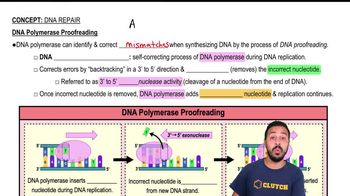
DNA Proofreading

DNA proofreading is a mechanism carried out by DNA polymerases during replication to detect and correct errors in the newly synthesized DNA strand, reducing the rate of mutations by ensuring accurate base pairing.
Recommended video:
Guided course
06:13
DNA Polymerase Proofreading

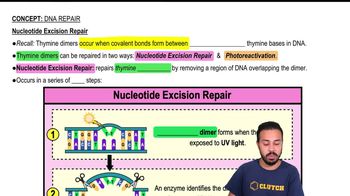
Excision Repair

Excision repair is a DNA repair process that removes damaged or incorrect bases from DNA strands and replaces them with the correct nucleotides, thereby preventing mutations from becoming permanent.
Recommended video:
Guided course
03:31
Nucleotide Excision Repair

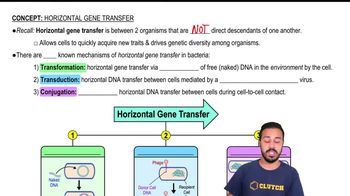
Horizontal Gene Transfer Mechanisms (Conjugation, Transduction, Transposons)

Conjugation, transduction, and transposons are mechanisms of horizontal gene transfer that introduce genetic variation but do not inherently prevent mutations; instead, they can sometimes increase genetic diversity or cause mutations.
Recommended video:
Guided course
04:42
Horizontal Gene Transfer