
Ch. 9 - Principles of Infectious Disease and Epidemiology
Norman-McKay- Microbiology: Basic and Clinical Principles 2nd Edition
Norman-McKay2nd EditionMicrobiology: Basic and Clinical PrinciplesISBN: 9780137661619Not the one you use?Change textbook
Chapter 9, Problem 1

In developed nations, which of the following are considered endemic diseases, and which are considered sporadic diseases?
Influenza: (endemic or sporadic)
Tetanus: (endemic or sporadic)
Plague: (endemic or sporadic)
Common cold: (endemic or sporadic)
Streptococcal pharyngitis: (endemic or sporadic)
Botulism: (endemic or sporadic)
Pneumonia: (endemic or sporadic)

Verified step by step guidance
1
Step 1: Understand the definitions of endemic and sporadic diseases. An endemic disease is one that is consistently present at a steady level within a particular geographic area or population. A sporadic disease occurs irregularly and infrequently, often in isolated cases or outbreaks without a predictable pattern.
Step 2: Analyze each disease based on its typical occurrence pattern in developed nations. For example, diseases like influenza and the common cold are regularly found in the population throughout the year, indicating endemic status.
Step 3: Identify diseases that occur irregularly or in isolated cases, such as tetanus and botulism, which are usually sporadic because they do not maintain a constant presence in the population.
Step 4: Consider diseases like plague, which are rare and occur in isolated outbreaks, classifying them as sporadic in developed nations.
Step 5: Summarize the classification by matching each disease to either endemic or sporadic based on the above reasoning, ensuring you understand the epidemiological patterns that define these categories.

Verified video answer for a similar problem:

This video solution was recommended by our tutors as helpful for the problem above.
Video duration:
2m
Was this helpful?

Key Concepts

Here are the essential concepts you must grasp in order to answer the question correctly.

Endemic Diseases

Endemic diseases are infections that consistently occur at a steady rate within a specific geographic area or population. They maintain a baseline level of presence without causing large outbreaks, such as the common cold in developed nations. Understanding endemicity helps in recognizing diseases that are regularly expected in a community.
Recommended video:
Guided course
04:57
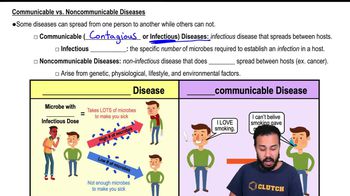
Communicable vs. Noncommunicable Diseases

Sporadic Diseases

Sporadic diseases appear irregularly and infrequently, with cases scattered and unpredictable in time and location. These diseases do not maintain a constant presence in a population, like tetanus or botulism in developed countries. Identifying sporadic diseases is important for outbreak detection and targeted public health responses.
Recommended video:
Guided course
04:57
Communicable vs. Noncommunicable Diseases

Disease Classification Based on Epidemiology

Classifying diseases as endemic or sporadic depends on their epidemiological patterns, including frequency, distribution, and transmission dynamics. This classification guides public health strategies, surveillance, and resource allocation. For example, influenza is endemic due to its regular seasonal occurrence, while plague is sporadic due to rare, isolated cases.
Recommended video: