
Ch. 10 - Classification of Microorganisms
Tortora - Microbiology: An Introduction 14th Edition
Tortora14th EditionMicrobiology: An IntroductionISBN: 9780138200398Not the one you use?Change textbook
Chapter 10, Problem 9

Use the following choices to answer questions 9 and 10.
1. 9 + 2 flagella
2. 70s ribosome
3. fimbria
4. nucleus
5. peptidoglycan
6. plasma membrane
Which is (are) found in all three domains?
a. 2,6
b. 5
c. 2,4,6
d. 1,3,5
e. all six

Verified step by step guidance
1
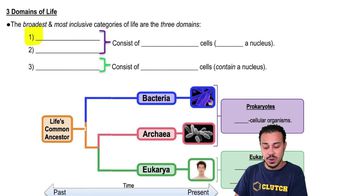
Step 1: Understand the three domains of life: Bacteria, Archaea, and Eukarya. The question asks which structures or features are found in all three domains.
Step 2: Review each choice and determine if it is present in Bacteria, Archaea, and Eukarya: 1) 9 + 2 flagella - this refers to the typical eukaryotic flagellar structure, not found in all domains; 2) 70s ribosome - found in Bacteria and Archaea, but Eukarya have 80s ribosomes; 3) fimbria - mainly found in Bacteria; 4) nucleus - only in Eukarya; 5) peptidoglycan - found in Bacteria cell walls, absent in Archaea and Eukarya; 6) plasma membrane - present in all cells across all domains.
Step 3: Identify which features are universal to all three domains. The plasma membrane (6) is found in all cells, and ribosomes are found in all cells but differ in size and type. Since 70s ribosomes are specific to prokaryotes, they are not universal.
Step 4: From the options, select the combination that includes only features found in all three domains. This will help eliminate options that include features unique to one or two domains.
Step 5: Conclude by matching the correct option letter with the features found in all three domains based on your analysis.

Verified video answer for a similar problem:

This video solution was recommended by our tutors as helpful for the problem above.
Was this helpful?

Key Concepts

Here are the essential concepts you must grasp in order to answer the question correctly.

The Three Domains of Life

The three domains—Bacteria, Archaea, and Eukarya—represent the broadest classification of life forms. Each domain has unique cellular features, but some structures are shared across all. Understanding these domains helps identify which cellular components are universal or domain-specific.
Recommended video:
Guided course
05:20
3 Domains of Life

Cellular Structures and Their Distribution

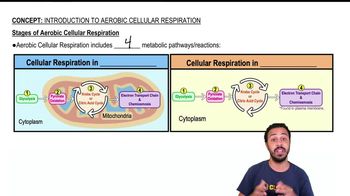
Key cellular structures like 70S ribosomes, plasma membranes, peptidoglycan, flagella, fimbriae, and nuclei vary among domains. For example, 70S ribosomes are found in prokaryotes (Bacteria and Archaea), while nuclei are exclusive to Eukarya. Recognizing which structures are common or unique is essential for domain identification.
Recommended video:
Guided course
02:32
Stages of Aerobic Cellular Respiration

Peptidoglycan and Its Domain Specificity

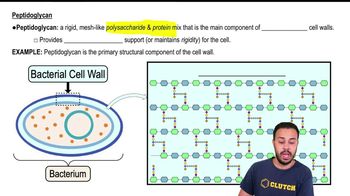
Peptidoglycan is a polymer forming the bacterial cell wall, providing rigidity and shape. It is found only in Bacteria, absent in Archaea and Eukarya. This specificity makes peptidoglycan a key marker for distinguishing bacterial cells from other domains.
Recommended video:
Guided course
01:58
Peptidoglycan