Ch. 13 - Viruses, Viroids, and Prions
Tortora - Microbiology: An Introduction 14th Edition
Tortora14th EditionMicrobiology: An IntroductionISBN: 9780138200398Not the one you use?Change textbook
Chapter 13, Problem 2

The molecule serving as mRNA can be incorporated in the newly synthesized virus capsids of all of the following except
a. + strand RNA picornaviruses.
b. + strand RNA togaviruses.
c. - strand RNA rhabdoviruses.
d. double-stranded RNA reoviruses.
e. Rotavirus.

Verified step by step guidance
1
Step 1: Understand the role of mRNA in viral replication. In positive-strand (+) RNA viruses, the viral genome itself acts as mRNA and can be directly translated by the host's ribosomes upon infection.
Step 2: Identify which virus types have + strand RNA genomes. Picornaviruses and togaviruses are examples of + strand RNA viruses, so their genomes can serve directly as mRNA and be packaged into new virions.
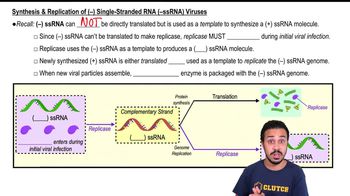
Step 3: Consider negative-strand (-) RNA viruses, such as rhabdoviruses. Their genomes are complementary to mRNA and cannot be directly translated; instead, they must be transcribed into mRNA by viral RNA-dependent RNA polymerase before translation. Therefore, the genome itself is not mRNA.
Step 4: Analyze double-stranded RNA viruses like reoviruses and rotaviruses. Their genomes consist of double-stranded RNA segments, which are not mRNA. These viruses carry their own polymerase to transcribe mRNA from the dsRNA genome inside the capsid.
Step 5: Conclude that the molecule serving as mRNA incorporated into newly synthesized virus capsids is present in + strand RNA viruses but not in - strand RNA or double-stranded RNA viruses. Thus, the exception is the virus type whose genome is not mRNA.

Verified video answer for a similar problem:

This video solution was recommended by our tutors as helpful for the problem above.
Video duration:
1m
Was this helpful?

Key Concepts

Here are the essential concepts you must grasp in order to answer the question correctly.

Positive-Strand (+) RNA Viruses and mRNA

Positive-strand RNA viruses have genomes that function directly as mRNA, allowing immediate translation upon infection. Their viral RNA can be directly incorporated into new virions as it serves both as genome and mRNA, seen in picornaviruses and togaviruses.
Recommended video:
Guided course
04:36
Replication of (-) Single Strand RNA Viruses

Negative-Strand (-) RNA Viruses and Genome Complementarity

Negative-strand RNA viruses carry genomes complementary to mRNA, so their RNA cannot serve directly as mRNA. Instead, they package RNA-dependent RNA polymerase to transcribe mRNA from the genome after infection, as in rhabdoviruses.
Recommended video:
Guided course
04:36
Replication of (-) Single Strand RNA Viruses

Double-Stranded RNA Viruses and Genome Packaging

Double-stranded RNA viruses, like reoviruses and rotaviruses, package their dsRNA genome segments inside the capsid. Their genome is not mRNA and requires transcription inside the virion to produce mRNA, so mRNA is not incorporated into new capsids.
Recommended video:
Guided course
04:28
Replication of Double-Stranded RNA Viruses