Compare biosynthesis of a + stranded RNA and a - stranded RNA virus.
Ch. 13 - Viruses, Viroids, and Prions

Tortora14th EditionMicrobiology: An IntroductionISBN: 9780138200398Not the one you use?Change textbook
Chapter 13, Problem 4
Which of the following would be the first step in the biosynthesis of a virus with reverse transcriptase?
a. A complementary strand of RNA must be synthesized.
b. Double-stranded RNA must be synthesized.
c. A complementary strand of DNA must be synthesized from an RNA template.
d. A complementary strand of DNA must be synthesized from a DNA template.
e. None of the above
Verified step by step guidance1
Understand that viruses with reverse transcriptase, such as retroviruses, have an RNA genome that needs to be converted into DNA inside the host cell.
Recall that reverse transcriptase is an enzyme that synthesizes DNA from an RNA template, which is the reverse of the usual transcription process.
Identify that the first step in the biosynthesis of such a virus involves creating a complementary DNA strand from the viral RNA genome.
Recognize that this step is crucial because the newly synthesized DNA can then integrate into the host genome for further replication and transcription.
Conclude that the correct first step is the synthesis of a complementary DNA strand from an RNA template, corresponding to option c.

Verified video answer for a similar problem:
This video solution was recommended by our tutors as helpful for the problem above.
Video duration:
2mWas this helpful?
Key Concepts
Here are the essential concepts you must grasp in order to answer the question correctly.
Reverse Transcriptase Function
Reverse transcriptase is an enzyme used by certain viruses, like retroviruses, to synthesize DNA from an RNA template. This process is the reverse of the usual transcription, allowing the viral RNA genome to be converted into DNA for integration into the host genome.
Recommended video:
Guided course
Functional Groups
Viral Genome Replication in Retroviruses
Retroviruses carry RNA genomes that must be reverse transcribed into DNA before replication. The first step in their biosynthesis involves creating a complementary DNA strand from the viral RNA, which then forms double-stranded DNA for integration.
Recommended video:
Guided course
Genome Variability
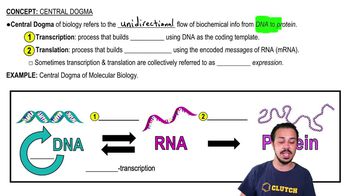
Central Dogma of Molecular Biology and Its Exceptions
The central dogma states that genetic information flows from DNA to RNA to protein. Reverse transcriptase viruses are exceptions, as they convert RNA back into DNA, highlighting the unique replication strategy of retroviruses.
Recommended video:
Guided course
Central Dogma
Related Practice
Textbook Question
1341
views
Textbook Question
List the four properties that define a virus. What is a virion?
2065
views
Textbook Question
Describe the four morphological classes of viruses, then diagram and give an example of each.
78
views
Textbook Question
Label the principal events of attachment, biosynthesis, entry, and maturation of a + stranded RNA virus. Draw in uncoating.
1233
views
Textbook Question
An example of lysogeny in animals could be
a. slow viral infections.
b. latent viral infections.
c. T-even bacteriophages.
d. infections resulting in cell death.
e. none of the above
905
views
Textbook Question
A virus with RNA-dependent RNA polymerase
a. synthesizes DNA from an RNA template.
b. synthesizes double-stranded RNA from an RNA template.
c. synthesizes double-stranded RNA from a DNA template.
d. transcribes mRNA from DNA.
e. none of the above
986
views