Ch. 16 - Innate Immunity: Nonspecific Defenses of the Host
Tortora - Microbiology: An Introduction 14th Edition
Tortora14th EditionMicrobiology: An IntroductionISBN: 9780138200398Not the one you use?Change textbook
Chapter 16, Problem 8

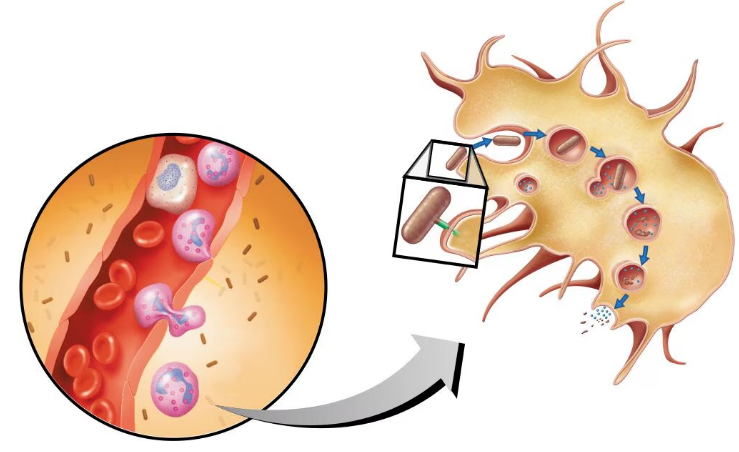
Label on the figure the following processes that result in phagocytosis: margination, diapedesis, adherence, and phagolysosome formation.
Diagram showing white blood cells migrating from blood vessels and engulfing bacteria through phagocytosis steps.

Verified step by step guidance
1
Step 1: Understand the sequence of events in phagocytosis starting from the movement of phagocytes towards the site of infection or injury. The first process to label is 'margination,' which is when leukocytes (white blood cells) move closer to the blood vessel walls in response to chemical signals.
Step 2: Next, identify and label 'diapedesis,' the process where leukocytes squeeze through the endothelial cells of the blood vessel wall to exit the bloodstream and enter the surrounding tissue.
Step 3: Then, label 'adherence,' which is the attachment of the phagocyte to the pathogen or foreign particle. This step is crucial for the phagocyte to engulf the target.
Step 4: Finally, label 'phagolysosome formation,' which occurs after the phagocyte engulfs the pathogen into a vesicle called a phagosome. The phagosome then fuses with a lysosome to form a phagolysosome, where the pathogen is digested by enzymes.
Step 5: On the figure, clearly mark each of these processes in the correct order along the path of the phagocyte from the blood vessel to the site of pathogen destruction, ensuring the labels correspond to the appropriate cellular structures and locations.

Verified video answer for a similar problem:

This video solution was recommended by our tutors as helpful for the problem above.
Video duration:
2m
Was this helpful?

Key Concepts

Here are the essential concepts you must grasp in order to answer the question correctly.

Margination

Margination is the process where white blood cells (leukocytes) move toward and adhere to the inner walls of blood vessels near the site of infection or injury. This is an early step in the immune response that prepares leukocytes for exiting the bloodstream to reach affected tissues.

Diapedesis

Diapedesis refers to the movement of leukocytes through the endothelial cells of blood vessel walls into surrounding tissues. This process allows immune cells to leave the bloodstream and migrate toward the site of infection or inflammation.
Recommended video:
Guided course
02:39
3) Vasodilation

Phagolysosome Formation

Phagolysosome formation occurs when a phagosome, containing an engulfed microbe, fuses with a lysosome inside a phagocytic cell. The resulting phagolysosome enables the degradation and destruction of the pathogen by lysosomal enzymes.
Recommended video:
Guided course
03:08
Formation & Breakdown of Polysaccharides