Ch. 17 - Adaptive Immunity: Specific Defenses of the Host
Tortora - Microbiology: An Introduction 14th Edition
Tortora14th EditionMicrobiology: An IntroductionISBN: 9780138200398Not the one you use?Change textbook
Chapter 17, Problem 3

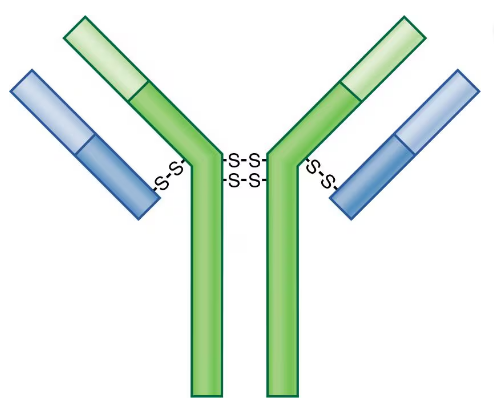
Label the heavy chains, light chains, and variable and Fc regions of this typical antibody. Indicate where the antibody binds to antigen. Sketch an IgM antibody.
Diagram of a typical antibody showing labeled heavy chains, light chains, variable and Fc regions, and antigen binding sites.

Verified step by step guidance
1
Start by drawing the basic Y-shaped structure of a typical antibody molecule. This structure consists of two identical heavy chains and two identical light chains.
Label the two longer polypeptide chains as the heavy chains. These form the inner part of each arm of the Y and extend down to form the stem of the Y.
Label the two shorter polypeptide chains as the light chains. These are attached to the outer side of each heavy chain on the arms of the Y.
Identify and label the variable regions at the tips of both the heavy and light chains on each arm of the Y. These variable regions are responsible for antigen binding.
Label the Fc region as the stem of the Y, which is formed by the constant regions of the heavy chains. This region interacts with immune cells and complement proteins.
Indicate the antigen binding sites at the tips of the variable regions on the arms of the Y, where the antibody specifically binds to the antigen.
For the IgM antibody sketch, draw a pentameric structure composed of five Y-shaped units connected by a joining (J) chain, forming a circular or star-like shape.

Verified video answer for a similar problem:

This video solution was recommended by our tutors as helpful for the problem above.
Video duration:
1m
Was this helpful?

Key Concepts

Here are the essential concepts you must grasp in order to answer the question correctly.

Antibody Structure

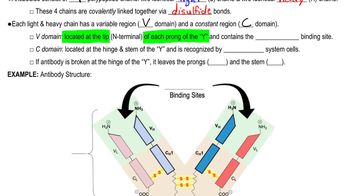
Antibodies are Y-shaped proteins composed of two heavy chains and two light chains linked by disulfide bonds. Each chain has variable and constant regions; the variable regions form the antigen-binding sites, while the constant regions determine the antibody's class and effector functions.
Recommended video:
Guided course
05:40
Antibody Structure

Variable and Fc Regions

The variable regions at the tips of the antibody arms bind specifically to antigens, providing immune specificity. The Fc (fragment crystallizable) region, formed by the constant domains of the heavy chains, mediates interactions with immune cells and complement proteins.
Recommended video:
Guided course
03:18
Genome Variability

IgM Antibody Structure and Function

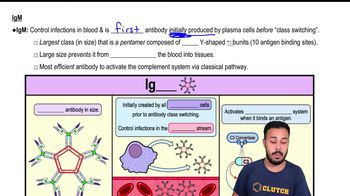
IgM antibodies are pentameric, consisting of five Y-shaped units connected by a J chain, making them large and effective at agglutination and complement activation. Their structure allows multiple antigen-binding sites, enhancing early immune response.
Recommended video: