Ch. 18 - Practical Applications of Immunology
Tortora - Microbiology: An Introduction 14th Edition
Tortora14th EditionMicrobiology: An IntroductionISBN: 9780138200398Not the one you use?Change textbook
Chapter 18, Problem 9

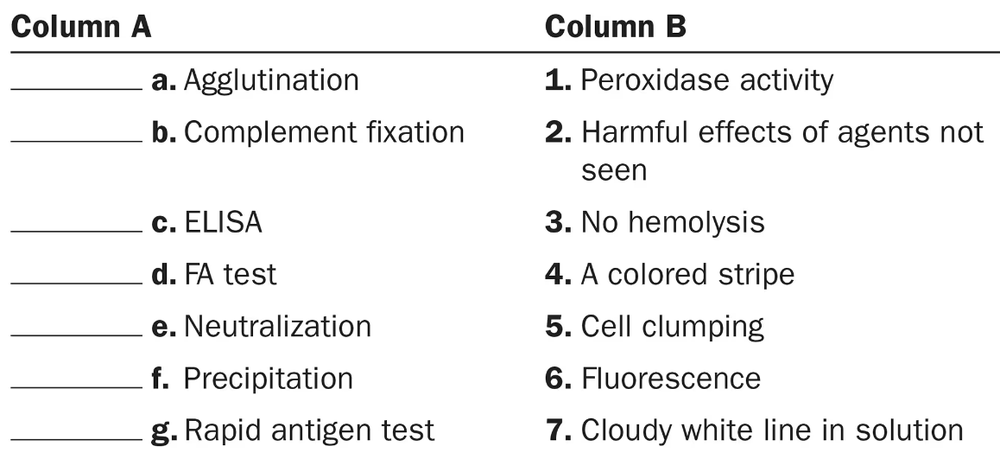
Match each of the following tests in column A to its positive reaction in column B.
Matching exercise with column A listing immunological tests and column B their positive reactions.

Verified step by step guidance
1
Since the problem involves matching tests to their positive reactions, start by identifying each test in column A and recalling the principle behind it—what biochemical or physiological change it detects in microorganisms.
For each test, review the typical positive result: for example, color changes, gas production, precipitate formation, or other visible indicators that signify a positive reaction.
Write down the characteristic positive reaction for each test based on your microbiology knowledge or reference materials, ensuring you understand why that reaction occurs.
Compare the positive reactions listed in column B with your notes for each test, and match them accordingly by linking the test to its corresponding positive result.
Double-check your matches by considering the biochemical basis of each test to confirm that the positive reaction logically fits the test's purpose and expected outcome.

Verified video answer for a similar problem:

This video solution was recommended by our tutors as helpful for the problem above.
Video duration:
4m
Was this helpful?

Key Concepts

Here are the essential concepts you must grasp in order to answer the question correctly.

Biochemical Tests in Microbiology

Biochemical tests are laboratory procedures used to identify microorganisms based on their metabolic activities. Each test detects specific enzymes or metabolic products, helping differentiate species by their unique biochemical reactions.
Recommended video:
Guided course
06:59
The Ames Test

Interpreting Positive Reactions

A positive reaction in a biochemical test indicates the presence of a particular enzyme or metabolic product. Recognizing color changes, gas production, or precipitate formation is essential to correctly match tests with their positive outcomes.
Recommended video:
Guided course
01:56
Chemical Reactions

Correlation Between Test and Microbial Function

Understanding how each biochemical test relates to microbial physiology allows accurate matching of tests to results. For example, a catalase test detects catalase enzyme activity by bubble formation, linking the test to its positive reaction.
Recommended video:
Guided course
06:59
The Ames Test