Ch. 19 - Disorders Associated with the Immune System
Tortora - Microbiology: An Introduction 14th Edition
Tortora14th EditionMicrobiology: An IntroductionISBN: 9780138200398Not the one you use?Change textbook
Chapter 19, Problem 5

Which of the following is not the cause of a natural immunodeficiency?
a. A recessive gene resulting in lack of a thymus gland
b. A recessive gene resulting in few B cells
c. HIV infection
d. Immunosuppressant drugs
e. All of the above are causes of natural immunodeficiency

Verified step by step guidance
1
Step 1: Understand the definition of natural immunodeficiency. Natural immunodeficiency refers to immune system defects that are present from birth, often due to genetic causes or congenital conditions.
Step 2: Analyze each option to determine if it represents a natural (congenital/genetic) cause or an acquired cause of immunodeficiency.
Step 3: Option (a) describes a recessive gene causing lack of a thymus gland, which is a congenital defect leading to immunodeficiency (natural cause).
Step 4: Option (b) describes a recessive gene causing few B cells, another genetic defect resulting in natural immunodeficiency.
Step 5: Option (c) HIV infection and option (d) immunosuppressant drugs are acquired causes of immunodeficiency, not natural. Therefore, these are not natural immunodeficiencies.

Verified video answer for a similar problem:

This video solution was recommended by our tutors as helpful for the problem above.
Video duration:
2m
Was this helpful?

Key Concepts

Here are the essential concepts you must grasp in order to answer the question correctly.

Natural vs. Acquired Immunodeficiency

Natural immunodeficiency refers to immune system defects present from birth, often due to genetic causes affecting immune cell development. Acquired immunodeficiency develops later in life due to external factors like infections or drugs. Understanding this distinction helps identify which causes are innate versus acquired.
Recommended video:
Guided course
06:53
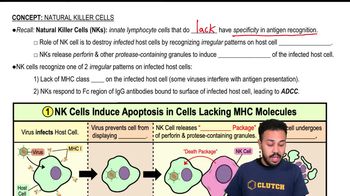
Natural Killer Cells

Genetic Causes of Immunodeficiency

Certain recessive genes can lead to congenital immunodeficiencies by impairing the development or function of immune organs or cells, such as the thymus gland or B cells. These genetic defects result in a reduced ability to mount immune responses from birth.
Recommended video:

Impact of HIV Infection and Immunosuppressant Drugs

HIV infection and immunosuppressant drugs cause acquired immunodeficiency by damaging or suppressing immune cells after birth. HIV targets T cells, while immunosuppressants reduce immune activity to prevent rejection or treat autoimmune diseases, both leading to weakened immunity.
Recommended video:
Guided course
05:58
Glucose Levels, cAMP, & the Lac Operon