
Ch. 20 - Antimicrobial Drugs
Tortora - Microbiology: An Introduction 14th Edition
Tortora14th EditionMicrobiology: An IntroductionISBN: 9780138200398Not the one you use?Change textbook
Chapter 20, Problem 10

Chloramphenicol binds to the 50S portion of a ribosome, which will interfere with:
a. Transcription in prokaryotic cells
b. Transcription in eukaryotic cells
c. Translation in prokaryotic cells
d. Translation in eukaryotic cells
e. DNA synthesis

Verified step by step guidance
1
Step 1: Understand the role of the ribosome in the cell. Ribosomes are the molecular machines responsible for protein synthesis, a process called translation, where mRNA is decoded to build proteins.
Step 2: Recognize the difference between the two main subunits of ribosomes: the 30S and 50S subunits in prokaryotes, and the 40S and 60S subunits in eukaryotes. Chloramphenicol specifically binds to the 50S subunit, which is part of the prokaryotic ribosome.
Step 3: Recall that transcription is the process of synthesizing RNA from DNA, which occurs in the nucleus and involves RNA polymerase, not ribosomes. Therefore, binding to the 50S ribosomal subunit does not affect transcription.
Step 4: Since chloramphenicol binds to the 50S subunit of prokaryotic ribosomes, it interferes with translation (protein synthesis) in prokaryotic cells, not eukaryotic cells.
Step 5: Conclude that the correct interference caused by chloramphenicol is with translation in prokaryotic cells, corresponding to option c.

Verified video answer for a similar problem:

This video solution was recommended by our tutors as helpful for the problem above.
Video duration:
2m
Was this helpful?

Key Concepts

Here are the essential concepts you must grasp in order to answer the question correctly.

Ribosome Structure and Function

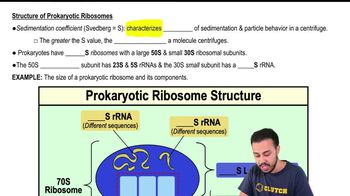
Ribosomes are cellular machines responsible for protein synthesis, composed of two subunits: the small (30S in prokaryotes, 40S in eukaryotes) and the large (50S in prokaryotes, 60S in eukaryotes). The 50S subunit in prokaryotes plays a key role in forming peptide bonds during translation, making it a target for certain antibiotics.
Recommended video:
Guided course
08:39
Structure of Prokaryotic Ribosomes

Mechanism of Action of Chloramphenicol

Chloramphenicol is an antibiotic that binds specifically to the 50S ribosomal subunit in prokaryotes, inhibiting the peptidyl transferase activity. This prevents peptide bond formation, thereby blocking translation and protein synthesis in bacterial cells without affecting eukaryotic ribosomes.
Recommended video:
Guided course
01:59
Introduction to Avoiding Host Defense Mechanisms

Difference Between Transcription and Translation

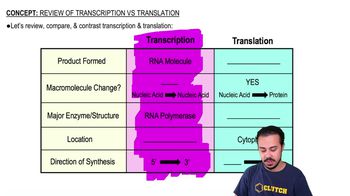
Transcription is the process of copying DNA into RNA, while translation is the synthesis of proteins from mRNA by ribosomes. Chloramphenicol affects translation by targeting ribosomes, not transcription or DNA synthesis, which are separate cellular processes.
Recommended video:
Guided course
04:07
Review of Transcription vs. Translation