
Textbook Question
Why does a cell die from the following antimicrobial actions?
a. Colistimethate binds to phospholipids.
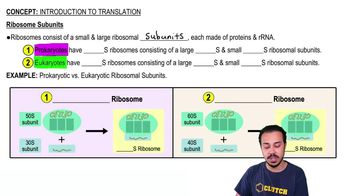
b. Kanamycin binds to 70S ribosomes.
765
views
 Verified step by step guidance
 05:03
05:03
 08:42
08:42 03:29
03:29Why does a cell die from the following antimicrobial actions?
a. Colistimethate binds to phospholipids.
b. Kanamycin binds to 70S ribosomes.
Cell membrane damage causes death because
a. The cell undergoes osmotic lysis.
b. Cell contents leak out.
c. The cell plasmolyzes.
d. The cell lacks a wall.
e. None of the above is correct.
Antibiotics that inhibit translation have side effects:
a. Because all cells have proteins
b. Only in the few cells that make proteins
c. Because eukaryotic cells have 80S ribosomes
d. At the 70S ribosomes in eukaryotic cells
e. None of the above is correct
Compare the method of action of the following pairs:
a. Penicillin and echinocandin
b. Imidazole and polymyxin B
List the advantages of using two chemotherapeutic agents simultaneously to treat a disease. What problem can occur when two drugs are used?
Which of the following will not affect eukaryotic cells?
a. Inhibition of the mitotic spindle
b. Binding with sterols
c. Binding to 80S ribosomes
d. Binding to DNA
e. All of the above will affect them